
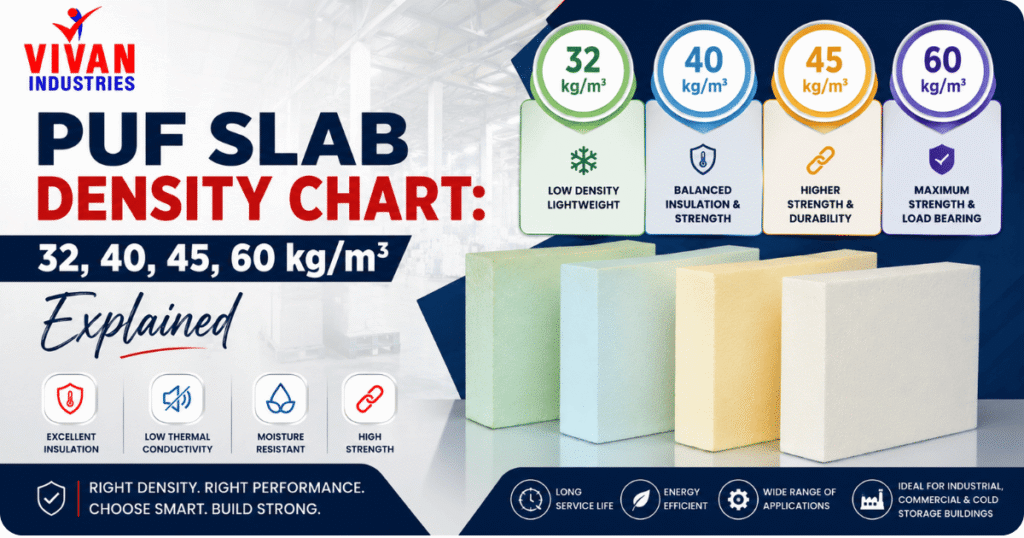
PUF slab density is the single most important number on a technical data sheet, yet it’s the one buyers understand least. This PUF slab density chart breaks down the four most common grades — 32 kg/m³, 40 kg/m³, 45 kg/m³, and 60 kg/m³ — so you can match the right polyurethane foam slab to your wall, roof, cold room, or industrial insulation project without over-paying or under-specifying. Whether you’re a procurement manager comparing quotes or an MEP consultant writing a tender spec, this guide gives you the density-to-performance data you actually need.
What Is PUF Slab Density and Why It Matters
PUF (Polyurethane Foam) slabs are rigid, closed-cell insulation boards manufactured by reacting polyol and isocyanate in the presence of a blowing agent. As the chemical mixture expands and cures, it forms millions of tiny closed cells — and how tightly those cells are packed determines the slab’s density, measured in kilograms per cubic metre (kg/m³).
Density isn’t a cosmetic spec. It directly governs three things a buyer actually cares about:
- Thermal performance — how well the slab resists heat flow (its K-value or thermal conductivity)
- Mechanical strength — how much load, foot traffic, or structural stress the slab can bear
- Cost and weight — higher density means more raw material per cubic metre, which raises both price and dead load
A low-density PUF slab (32 kg/m³) is cheaper and lighter but weaker. A high-density PUF slab (60 kg/m³) costs more but can carry structural load and survive rough handling. Getting this trade-off wrong is one of the most common — and most expensive — mistakes in industrial insulation procurement.
PUF Slab Density Chart: 32, 40, 45 & 60 kg/m³ Compared
Here is the core PUF slab density chart most Indian manufacturers, EPC contractors, and cold storage builders reference when specifying rigid polyurethane foam slabs.
| Density (kg/m³) | Compressive Strength (kg/cm²) | Typical Use Case | Relative Cost |
|---|---|---|---|
| 32 kg/m³ | 1.2 – 1.6 | Non-load-bearing wall infill, false ceilings, general thermal lining | Lowest |
| 40 kg/m³ | 1.8 – 2.2 | Standard cold storage walls, ceilings, sandwich panel cores | Moderate |
| 45 kg/m³ | 2.2 – 2.8 | Cold room floors, doors, and areas with foot traffic or light load | Moderate-High |
| 60 kg/m³ | 3.0 – 4.0 | Structural/load-bearing floors, blast freezer bases, high-traffic industrial floors | Highest |
PUF Slab Density vs Thermal Conductivity (K-Value)
A common misconception is that higher-density PUF slabs insulate better. In reality, thermal conductivity (K-value) changes only marginally across this density range — the real driver of insulation performance is slab thickness, not density. Here’s how the numbers compare:
| Density (kg/m³) | Thermal Conductivity K-Value (W/m·K) | Insulation Behaviour |
|---|---|---|
| 32 kg/m³ | 0.022 – 0.024 | Excellent — lowest structural material content per volume |
| 40 kg/m³ | 0.022 – 0.023 | Excellent — industry-standard baseline |
| 45 kg/m³ | 0.023 – 0.025 | Very good — slightly denser cell structure |
| 60 kg/m³ | 0.024 – 0.027 | Good — extra structural material marginally raises conductivity |
This is why 40 kg/m³ PUF slab remains the industry default for cold storage walls: it delivers near-optimal thermal conductivity while staying light enough to keep structural loads and material costs down.
PUF Slab Density vs Compressive Strength and Load-Bearing Capacity
If thermal conductivity barely changes with density, compressive strength changes dramatically — and this is the number that should really drive your buying decision.
| Density (kg/m³) | Compressive Strength | Can It Bear Foot Traffic? | Can It Bear Racking/Structural Load? |
|---|---|---|---|
| 32 kg/m³ | Low | No | No |
| 40 kg/m³ | Moderate | Occasional, light traffic only | No |
| 45 kg/m³ | Good | Yes | Light structural load only |
| 60 kg/m³ | High | Yes, heavy traffic | Yes — suitable for racking, mezzanine floors, forklift zones |
Which PUF Slab Density Should You Choose? (Application-Wise Guide)
32 kg/m³ PUF Slab — Best for Non-Structural Insulation
Choose 32 kg/m³ when the slab is purely a thermal barrier with no load exposure — think partition wall cores, false ceiling insulation, or duct lining in HVAC systems. It’s the most economical PUF board density and works well anywhere weight savings matter, such as prefab site offices or portable cabins.
40 kg/m³ PUF Slab — The Industry Standard
This is the most widely specified PUF slab density in India, and for good reason: it balances thermal conductivity, compressive strength, and cost almost perfectly. It’s the default choice for cold storage walls, ceilings, sandwich panel cores, refrigerated transport bodies, and general industrial cladding.
45 kg/m³ PUF Slab — For Floors and Foot Traffic Zones
Where a slab will see regular foot traffic — cold room floors, walk-in freezer bases, processing area floors — 45 kg/m³ provides the extra compressive strength needed to resist dimpling and long-term deformation under repeated loading, without jumping all the way to structural-grade density.
60 kg/m³ PUF Slab — For Structural and Heavy-Load Applications
Reserve 60 kg/m³ for applications carrying real structural or dynamic load: blast freezer floors, racking-supported cold storage, forklift-trafficked zones, and marine/buoyancy applications where mechanical robustness matters more than marginal cost savings.
PUF Slab Density vs EPS and XPS: A Quick Semantic Comparison
Buyers often compare PUF slab density against EPS (thermocol) and XPS density during procurement. As a quick reference: EPS boards typically run 15–25 kg/m³ with markedly lower compressive strength and higher K-values, while XPS sits closer to 28–40 kg/m³ with moisture resistance but lower fire performance than rigid polyurethane foam. For industrial and cold-chain projects, PUF and PIR slabs generally outperform both on the strength-to-thermal-performance ratio at comparable density. (For a full breakdown, see our detailed PUF vs EPS vs XPS comparison guide.)
How PUF Slab Density Is Tested (Standards & Certification)
Reliable density data isn’t a marketing claim — it should be lab-verified. In India, PUF slab manufacturers are expected to test and certify density and related properties against:
- IS 12436 — Bureau of Indian Standards specification for rigid polyurethane foam for thermal insulation (bis.gov.in)
- ASTM D1622 — International standard test method for apparent density of rigid cellular plastics (astm.org)
- ISO 845 — Determination of apparent density for rigid and flexible cellular plastics
Always ask your supplier for a batch test certificate showing measured density, not just the nominal spec sheet figure — actual PUF slab density can drift ±2–3 kg/m³ from the stated value depending on production consistency.
You May Also Read – What Are PUF Slabs? Composition, Properties & Industrial Uses
How PUF Slab Density Is Controlled During Manufacturing
PUF slab density isn’t set by eye — it’s engineered at the mixing stage. Manufacturers control the ratio of polyol to isocyanate, the amount of blowing agent, mould pressure, and curing time to hit a target density within a tight tolerance (usually ±2 kg/m³). A few factors that influence the final PUF slab density:
- Blowing agent dosage — more blowing agent creates more cells and lowers density; less blowing agent produces a denser, stronger slab
- Mould pressure and free-rise vs. moulded foaming — moulded (pressed) foam typically achieves more uniform density than free-rise blocks
- Ambient temperature during pour — inconsistent shop-floor temperature is one of the biggest causes of density drift between batches
- Skin vs. core density — self-skin PUF slabs have a denser outer layer than the core, so “average density” and “core density” figures can differ meaningfully on a spec sheet
This is exactly why a lab test certificate matters more than a printed brochure figure — two slabs both labelled “40 kg/m³” can perform quite differently depending on how tightly the manufacturer controls this process.
Buyer’s Checklist: How to Verify PUF Slab Density Before You Buy
- Request the manufacturer’s test certificate (IS 12436 / ASTM D1622), not just a catalogue spec sheet
- Match density to actual load exposure — don’t over-spec 60 kg/m³ where 40 kg/m³ suffices
- Confirm closed-cell content (should be 92%+ for genuine rigid PUF slab performance)
- Check whether density is quoted as “core density” or “average density with skin” — the two differ
- Ask about batch-to-batch consistency and ISO 9001:2015 certification of the manufacturing facility
- Cross-verify compressive strength and K-value figures against the density chart above — a mismatch signals inflated or unverified specs
Why Choose Vivan Industries for PUF & PIR Slabs
Vivan Industries, based in Vadodara, Gujarat, has been manufacturing PUF/PIR slabs, pipe sections, pipe supports, and cold storage sandwich panels since 2015. As an ISO 9001:2015-certified, government-lab-approved manufacturer serving 55+ industrial and B2B clients — including refineries, chemical and petrochemical plants, dairy and pharma facilities, and cold storage builders — Vivan Industries supplies PUF slabs across the full 32–60 kg/m³ density range, each backed by verifiable lab test data rather than catalogue-only claims. For procurement managers and EPC contractors across Gujarat’s industrial corridor (Hazira, Dahej, Ankleshwar) and PAN-India, Vivan Industries offers custom density and thickness combinations engineered to your project’s exact thermal and structural requirements. (Explore the complete PUF & PIR Insulation Slabs manufacturer’s guide or the Complete Guide to Industrial Thermal Insulation for more.)
Choosing the right PUF slab density comes down to matching compressive strength and load exposure to your application — not chasing the highest number on a spec sheet. Use 32 kg/m³ for non-structural insulation, 40 kg/m³ as your default cold storage and wall panel choice, 45 kg/m³ for floors and foot-traffic zones, and 60 kg/m³ only where genuine structural or heavy-load performance is required. Always validate density claims against a lab test certificate (IS 12436 / ASTM D1622) before finalising your order, and work with an ISO-certified, government-lab-approved manufacturer such as Vivan Industries to ensure the PUF slab density you pay for is the PUF slab density you actually receive.
Conclusion
Choosing the right PUF slab density comes down to matching compressive strength and load exposure to your application — not chasing the highest number on a spec sheet. Use 32 kg/m³ for non-structural insulation, 40 kg/m³ as your default cold storage and wall panel choice, 45 kg/m³ for floors and foot-traffic zones, and 60 kg/m³ only where genuine structural or heavy-load performance is required. Always validate density claims against a lab test certificate (IS 12436 / ASTM D1622) before finalising your order, and work with an ISO-certified, government-lab-approved manufacturer such as Vivan Industries to ensure the PUF slab density you pay for is the PUF slab density you actually receive.
Frequently Asked Questions
1. What is the standard PUF slab density used in India?
The most common PUF slab density in India is 40±2 kg/m³, widely used for cold storage walls, ceilings, and general industrial insulation because it balances thermal conductivity, compressive strength, and cost.
2. Which PUF slab density is best for cold storage floors?
45 kg/m³ is generally recommended for cold storage floors and areas with regular foot traffic, since it offers higher compressive strength than 40 kg/m³ without the added cost of structural-grade 60 kg/m³ slabs.
3. Does higher PUF slab density mean better insulation? Not significantly.
Thermal conductivity changes only marginally between 32 kg/m³ and 60 kg/m³ PUF slabs; insulation performance is driven more by slab thickness than by density.
4. What is the compressive strength of a 60 kg/m³ PUF slab?
A 60 kg/m³ PUF slab typically offers compressive strength in the range of 3.0–4.0 kg/cm², making it suitable for structural floors, racking-supported cold storage, and forklift-trafficked areas.
5. How is PUF slab density tested?
PUF slab density is tested using standards such as IS 12436 (Bureau of Indian Standards) and ASTM D1622, which measure the apparent density of rigid cellular plastics from representative sample cubes.
6. What density PUF slab is used for wall panels?
32–40 kg/m³ PUF slabs are typically used for wall panels and non-load-bearing partitions, offering good thermal insulation at a lower material cost.
7. Is 32 kg/m³ PUF slab suitable for cold storage?
32 kg/m³ is generally too low-strength for cold storage floors or structural walls; it’s better suited to non-structural applications like false ceilings, duct lining, or partition cores.
8. What’s the difference between PUF slab density and PIR slab density?
PIR (Polyisocyanurate) slabs are typically manufactured in similar density ranges to PUF but offer better fire retardance and higher-temperature performance, making density comparisons alone insufficient — fire rating should also be checked.
9. How much does PUF slab density affect price?
Price generally scales with density — a 60 kg/m³ PUF slab can cost roughly 30–50% more than a 32 kg/m³ slab of the same thickness, due to higher raw material consumption per cubic metre.
10. Can I get custom PUF slab density from a manufacturer?
Yes — established manufacturers like Vivan Industries can produce custom PUF slab densities and thicknesses tailored to specific project load, thermal, and budget requirements.