
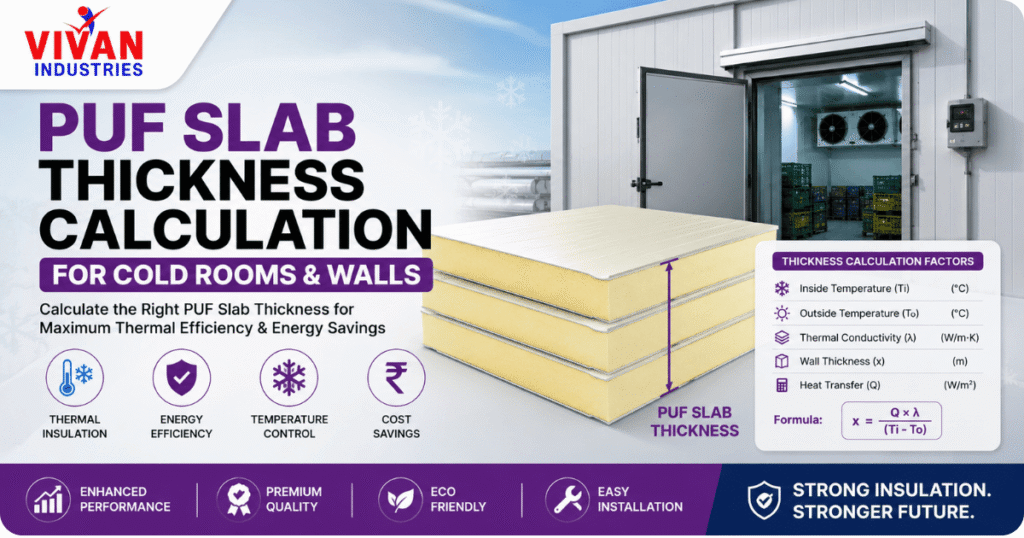
PUF slab thickness calculation is the process of sizing a rigid polyurethane foam (PUF) slab so it holds the desired temperature difference at an acceptable heat-gain rate — get it wrong and you either overspend on foam or lose your set-point and run compressors overtime. The working formula is simple: Thickness = (Thermal Conductivity × Temperature Difference) ÷ Target Heat Gain. Applied correctly, this same PUF slab thickness calculation tells you that a standard 0–4°C cold store needs roughly 60–80 mm, a -18°C deep freeze needs 100–120 mm, and a -40°C blast freezer needs 150 mm or more. This guide walks through the formula, a worked example, application-wise thickness charts, and the mistakes that quietly inflate energy bills.
What Is PUF Slab Thickness Calculation and Why It Matters
Every rigid PUF slab resists heat transfer, but by exactly how much depends on three variables working together: the thickness of the slab, its thermal conductivity (k-value), and the temperature difference it has to hold. PUF slab thickness calculation is simply the engineering step of solving for the one unknown — thickness — once you know the other two, plus how much heat gain your refrigeration system can economically handle.
Skipping this calculation causes two expensive problems in opposite directions:
- Under-insulation: excess heat gain forces compressors to run longer, spikes energy bills, causes condensation and frost build-up, and shortens equipment life.
- Over-insulation: unnecessary slab thickness adds material cost, structural load, and floor-to-ceiling height loss without a meaningful energy payback.
For background on how the foam itself is graded before you even get to thickness, see our PUF slab density chart — density and thickness are solved together, not separately, as covered later in this guide.
The PUF Slab Thickness Calculation Formula (Step-by-Step)
The industry-standard method used by insulation engineers is based on Fourier’s law of heat conduction. In its simplified, project-usable form:
Thickness (m) = [k (W/mK) × ΔT (°C)] ÷ q (target heat gain, W/m²)
Where:
- k = thermal conductivity of the PUF slab (typically 0.022–0.025 W/mK — check the density-specific value on your test certificate)
- ΔT = temperature difference between the outside ambient and the desired internal set-point
- q = the target/allowable heat gain per square metre, usually 6–10 W/m² for cold storage design
Worked Example
| Input | Value |
| Desired internal temperature | -18°C (deep freeze) |
| External ambient temperature | 35°C |
| Temperature difference (ΔT) | 53°C |
| PUF slab thermal conductivity (k) | 0.023 W/mK |
| Target heat gain (q) | 8 W/m² |
| Calculated thickness | 0.023 × 53 ÷ 8 = 0.152 m ≈ 152 mm |
This worked example lands squarely inside the 120–150 mm range that deep-freeze rooms typically use in the field, which is a useful sanity check whenever you run your own numbers.
PUF Slab Thickness Chart by Application (Quick Reference)
For a fast, standards-aligned starting point before running the full calculation, use this quick-reference PUF slab thickness chart.
| Application | Typical Temperature Range | Recommended PUF Thickness |
| Ambient wall / partition insulation | Room temperature | 40–50 mm |
| Standard cold storage (chiller) | 0°C to 4°C | 60–80 mm |
| Deep freeze storage | -18°C to -25°C | 100–120 mm |
| Blast freezer rooms | -40°C and below | 150 mm+ |
| Pharma / GMP cold rooms | 2°C to 8°C (tight tolerance) | 80–100 mm |
| Hot-climate roofing | Ambient, high solar load | 60–80 mm |
These are starting benchmarks, not substitutes for the formula above — always verify against your actual ambient temperature, target set-point, and PUF slab density using the calculation method. Our PUF vs EPS vs XPS comparison is a useful next read if you’re still deciding on the base insulation material before finalising thickness.
How PUF Slab Density Affects the Thickness Calculation
Thickness and density are not independent decisions — a higher-density PUF slab has a marginally different thermal conductivity, which changes the thickness needed to hit the same heat-gain target. This is why the density grade should be locked in before the final thickness calculation is run.
| PUF Slab Density | Typical k-value (W/mK) | Thickness for ΔT = 53°C, q = 8 W/m² |
| 32 kg/m³ | 0.021 | 0.021 × 53 ÷ 8 ≈ 139 mm |
| 40 kg/m³ | 0.023 | 0.023 × 53 ÷ 8 ≈ 152 mm |
| 45 kg/m³ | 0.024 | 0.024 × 53 ÷ 8 ≈ 159 mm |
| 60 kg/m³ | 0.025 | 0.025 × 53 ÷ 8 ≈ 166 mm |
As the table shows, higher-density PUF slabs need slightly more thickness for the same thermal target, because thermal conductivity rises marginally with density — full explanation and strength trade-offs in our PUF slab density chart guide.
Cold Room vs Wall Insulation — Different Thickness Logic
Cold Room Walls & Ceiling
Walls and ceilings face a fairly constant ambient-to-internal ΔT and are the primary surfaces the thickness formula is built for. Use the full ΔT between the harshest expected ambient temperature and the coldest internal set-point.
Cold Room Floors
Floors behave differently because they sit against the ground, not open air, so the effective ΔT is smaller — but floors also need under-slab insulation (commonly EPS or XPS boards, 50–100 mm) beneath the PUF layer to stop ground heave from frozen soil, plus a vapour barrier on the warm side to stop moisture migrating into the foam over time.
Roofs
Roofs carry the highest solar heat load of any surface, so in hot-climate regions like Gujarat it’s common to add 10–20 mm over the wall thickness calculated for the same room.
You May Also Read – PUF Slab Density Chart: 32, 40, 45, 60 kg/m³ Explained
Common Mistakes in PUF Slab Thickness Calculation
- Using a generic k-value instead of the tested value for your specific PUF slab density.
- Calculating ΔT from average ambient temperature instead of peak summer ambient — undersizes the slab for the worst-case load.
- Applying one blanket thickness to walls, roof, and floor instead of solving each surface separately.
- Ignoring the vapour barrier — even a correctly sized PUF slab underperforms if moisture infiltrates the foam over time.
- Skipping the density-thickness trade-off and assuming any density slab of a given thickness performs identically.
PUF Slab Thickness Calculation Checklist
| Input Needed | Where to Get It |
| Desired internal set-point temperature | Project/process requirement (e.g., -18°C for deep freeze) |
| Peak external ambient temperature | Local climate data for your project location |
| PUF slab thermal conductivity (k) | Manufacturer’s lab test certificate for the chosen density |
| Target allowable heat gain (q) | Refrigeration/MEP consultant’s design brief, typically 6–10 W/m² |
| Surface type (wall, roof, or floor) | Project drawings — each surface is calculated separately |
Why Choose Vivan Industries for Thickness-Engineered PUF Slabs
Vivan Industries (Vadodara, Gujarat) is an ISO 9001:2015 certified, Government Lab Approved manufacturer with 9+ years of experience supplying PUF and PIR insulation slabs to 55+ industrial and B2B clients, including cold storage builders, EPC contractors, and pharma facilities. Every batch is manufactured to the density and thickness combination your project’s heat-load calculation actually requires — not a one-size-fits-all stock thickness — with lab test certification available on request.
Get a project-specific PUF slab thickness calculation and quote at Vivan Industries, or explore the full PUF & PIR Insulation Slabs guide for sizes and manufacturing details — serving Vadodara, Ankleshwar, Dahej, Hazira, Jamnagar, Mumbai, Pune, and Chennai industrial corridors.
Frequently Asked Questions
1. What is the formula for PUF slab thickness calculation?
Thickness (m) = [Thermal Conductivity (k, W/mK) × Temperature Difference (ΔT, °C)] ÷ Target Heat Gain (q, W/m²). This is the standard engineering method used for cold storage and industrial insulation sizing.
2. What thickness of PUF slab is needed for a -18°C cold room?
For a typical deep-freeze room at -18°C with a 35°C ambient and standard heat-gain targets, the calculation lands around 100–120 mm, depending on the exact PUF slab density used.
3. Does PUF slab density affect the thickness required?
Yes. Higher-density PUF slabs have a slightly higher thermal conductivity, so they require marginally more thickness than a lower-density slab to hit the same thermal target.
4. What is the minimum PUF slab thickness for wall insulation?
For general ambient-temperature wall or partition insulation, 40–50 mm is typically sufficient. Cold storage walls require significantly more, based on the calculation.
5. How thick should PUF slabs be for blast freezer rooms?
Blast freezer rooms operating at -40°C or below typically require 150 mm or thicker PUF slabs, and should always be confirmed with a project-specific calculation.
6. What temperature difference should I use in the calculation?
Use the peak external ambient temperature expected at your project site minus the desired internal set-point — not the average temperature — to avoid undersizing the insulation for worst-case conditions.
7. Can I use the same thickness for walls, roof, and floor?
No. Roofs carry higher solar heat load and often need extra thickness, while floors require a different approach involving under-slab insulation and a smaller effective ΔT against the ground.
8. What is a typical k-value used for PUF slab thickness calculation?
Most PUF slabs used in Indian cold storage projects have a thermal conductivity between 0.022 and 0.025 W/mK — always confirm the exact figure from your supplier’s lab test certificate rather than assuming a generic value.
9. How does climate affect PUF slab thickness?
Hotter regions with higher peak ambient temperatures produce a larger ΔT in the formula, which increases the calculated thickness needed to hold the same internal set-point and heat-gain target.
10. Who can help calculate PUF slab thickness for my project?
A qualified insulation manufacturer or MEP/refrigeration consultant can run this calculation using your project’s exact ambient temperature, set-point, and PUF slab density — Vivan Industries offers this as part of its project consultation.
Conclusion
PUF slab thickness calculation isn’t guesswork — it’s a straightforward formula once you know your temperature difference, thermal conductivity, and target heat gain. Use 40–50 mm for ambient walls, 60–80 mm for standard cold storage, 100–120 mm for deep freeze, and 150 mm+ for blast freezer applications as your starting benchmarks, then verify with the calculation for your exact project conditions. Vivan Industries supplies ISO 9001:2015-certified PUF and PIR slabs across every density and thickness combination this guide covers, manufactured from its Vadodara facility with test certification available on request.