
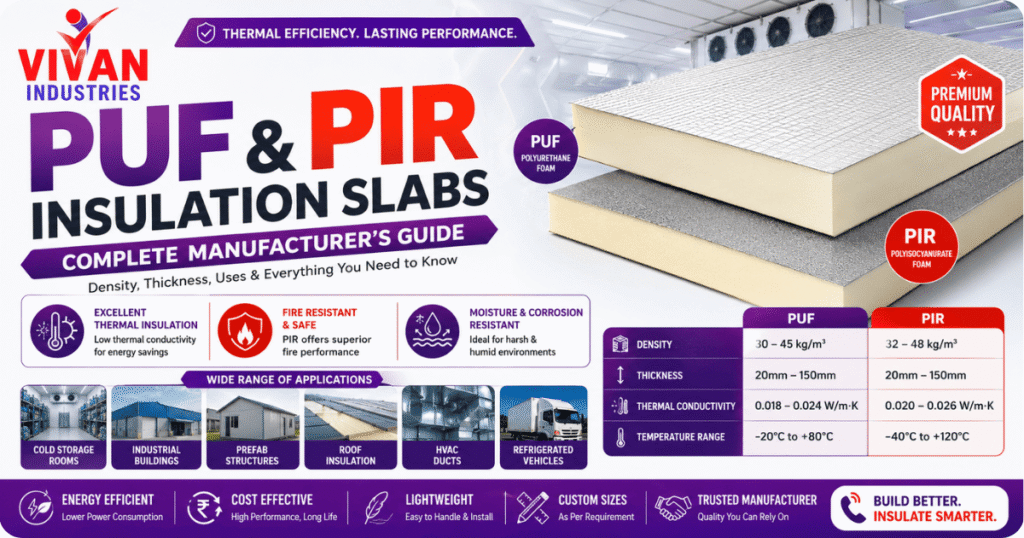
PUF & PIR insulation slabs are the backbone of modern thermal insulation in India — and this complete manufacturer’s guide breaks down density, thickness, uses, and how to choose the right slab for your project. Whether you’re insulating a cold storage facility, a chemical pipeline, a refrigerated warehouse, or a green building envelope, polyurethane foam (PUF) and polyisocyanurate (PIR) rigid slabs deliver the lowest thermal conductivity per millimetre on the market. As a trusted PUF & PIR insulation slabs manufacturer, Vivan Industries engineers high-density, fire-retardant, dimensionally stable boards built for India’s humid, high-temperature operating conditions.
This guide covers everything a procurement engineer, MEP consultant, or facility owner needs — from raw-material chemistry and density grades to thickness selection charts, real-world applications, code compliance, and a 10-question FAQ that answers what buyers actually search for.
What Are PUF & PIR Insulation Slabs?
PUF (Polyurethane Foam) slabs are rigid, closed-cell foam boards produced by reacting polyol with isocyanate (MDI). They deliver a thermal conductivity (λ) of roughly 0.022–0.026 W/m·K, making PUF one of the most efficient insulation materials per millimetre of thickness.
PIR (Polyisocyanurate) slabs are a chemically advanced cousin of PUF. By adjusting the isocyanate-to-polyol ratio and curing at higher temperatures, PIR foam forms a more thermally stable isocyanurate ring structure. The result: superior fire performance, a higher service-temperature ceiling (up to ~140 °C continuous), and a marginally lower λ of around 0.021–0.024 W/m·K.
Both are supplied as rigid slabs/boards in standard sizes (typically 1000 × 500 mm, 1200 × 600 mm, or 2000 × 1000 mm) and customised cuts for site fit-up. At Vivan Industries’ Vadodara facility, slabs are pressure-injected, cured under controlled humidity, and CNC-trimmed for dimensional accuracy of ±1 mm.
Why Choose Rigid Polyurethane & Polyisocyanurate Boards?
- Lowest λ-value among commercial insulants — half the thickness of mineral wool for the same R-value.
- Closed-cell structure (>92%) prevents water absorption and condensation drip in cold-side applications.
- Lightweight (35–60 kg/m³) yet structurally rigid — easy to handle, no special lifting equipment required.
- Fire-retardant grades (FR-PUF and PIR) meet IS 12436, ASTM E84 Class 1, and BS 476 Part 7 ratings.
- Long service life — 25+ years with negligible thermal drift when properly vapour-sealed.
- CFC/HCFC-free blowing agents comply with the Montreal Protocol and India’s ODS Rules 2014.
PUF vs PIR Slabs — Side-by-Side Comparison
| Property | PUF Slab | PIR Slab |
| Chemistry | Polyurethane foam | Polyisocyanurate foam |
| Thermal Conductivity (λ) | 0.022–0.026 W/m·K | 0.021–0.024 W/m·K |
| Service Temperature | −180 °C to +110 °C | −200 °C to +140 °C |
| Fire Performance | Class 2 (FR grade) | Class 1 / B-s2,d0 |
| Compressive Strength | 1.8–2.5 kg/cm² | 2.0–3.0 kg/cm² |
| Closed-Cell Content | ≥ 90% | ≥ 92% |
| Water Absorption | < 2% by volume | < 1.5% by volume |
| Typical Density Range | 35–60 kg/m³ | 38–60 kg/m³ |
| Cost Index | Baseline (1.0×) | 1.15–1.30× |
| Best For | Cold storage, ducting, walls | LNG, high-temp pipelines, fire-critical zones |
Source: Vivan Industries QA lab data, batch averages 2024–2025.
Density Grades — Choosing the Right Kg/m³
Density directly governs compressive strength, dimensional stability, and (to a smaller extent) thermal performance. Going too high wastes money; going too low risks foam crush under load.
| Density (kg/m³) | Recommended Application | Compressive Strength | λ-value (W/m·K) |
| 32 ± 2 | Ceilings, false roofs, lightweight cladding | ~1.4 kg/cm² | 0.024 |
| 40 ± 2 | Cold rooms, wall panels, HVAC ducts (most common) | ~2.0 kg/cm² | 0.022 |
| 45 ± 2 | Refrigerated trucks, blast freezers, marine | ~2.3 kg/cm² | 0.022 |
| 50 ± 2 | Floor insulation under screed, light traffic | ~2.6 kg/cm² | 0.023 |
| 60 ± 2 | Industrial cold floors, LNG bunds, heavy load | ~3.0 kg/cm² | 0.024 |
Pro tip from Vivan Industries: Density isn’t the same as quality. A well-cured 40 kg/m³ PIR slab with 94% closed cells will out-perform a poorly blown 50 kg/m³ board. Always ask the manufacturer for batch-wise QA reports.
Thickness Selection — Matching Slab Depth to Application
Thickness drives the R-value (thermal resistance). The thicker the slab, the higher the R-value — but diminishing returns kick in beyond a point, so design economics matter.
| Thickness | R-value (m²·K/W) | Typical Use Case |
| 25 mm | ~1.04 | Door panels, light partitions |
| 40 mm | ~1.67 | AC duct insulation, false ceilings |
| 50 mm | ~2.08 | Cold-room walls (above 0 °C) |
| 75 mm | ~3.12 | Walk-in freezers, dairy plants |
| 100 mm | ~4.16 | Blast freezers, ice plants (−25 °C) |
| 125 mm | ~5.20 | Pharma cold chain (−40 °C) |
| 150 mm | ~6.25 | LNG storage, cryogenic vessels |
Vivan Industries supplies PUF & PIR insulation slabs in thicknesses from 15 mm to 150 mm, with custom cuts up to 200 mm available on indent. For multi-layer installations, staggered joints reduce thermal bridging by up to 18% — a detail covered in our thermal insulation solutions guide.
You May Also Read – Cold Room Panels 2026: PUF Price & Top Manufacturers
Top Industrial Uses of PUF & PIR Slabs
- Cold Storage & Refrigerated Warehouses — PUF slabs at 100–125 mm form the thermal envelope for fruit, dairy, and pharma cold chains.
- Chemical & Petrochemical Pipelines — PIR boards handle line temperatures from −200 °C up to +140 °C with negligible degradation. Pair with our PUF/PIR pipe sections for full system insulation.
- HVAC Ductwork — 25–50 mm PUF slabs cut acoustic transmission and prevent condensation on chilled-water ducts.
- Pre-Engineered Buildings (PEB) & Sandwich Panels — Density 40 kg/m³ slabs are the foam core of insulated wall & roof panels.
- Refrigerated Transport — Reefer truck bodies use 75–100 mm boards bonded between FRP skins.
- LNG/LPG Storage Tanks — Multi-layer PIR insulation slabs minimise boil-off losses.
- Green & Energy-Efficient Buildings — IGBC/LEED-aligned envelopes use PIR for low embodied energy per R-value.
- Industrial Roofing — Over-deck PIR boards cut heat ingress by 40–55% in metal roof systems.
- Dairy, Brewery & Food-Processing Plants — Hygienic, washable slab faces meet FSSAI compliance.
- In-Situ Cavity Insulation — Where slabs aren’t feasible, our in-situ PU foam service fills voids seamlessly.
Vivan Industries — Your PUF & PIR Slab Manufacturing Partner
Founded in 2015 and headquartered in Vadodara, Gujarat, Vivan Industries has delivered insulation solutions to 55+ clients across petrochemical, dairy, pharma, cold-chain, and PEB sectors. Our PUF & PIR slabs are produced on calibrated high-pressure machines, lab-tested per IS 12436, ASTM C518, and ISO 8301, and shipped pan-India with project-ready documentation.
- Density grades from 32 to 60 kg/m³, customised on order
- Thicknesses 15 mm to 200 mm with ±1 mm tolerance
- FR-grade PUF and self-extinguishing PIR boards
- CNC-cut profiles, bevels, and tongue-and-groove edges
- Batch-wise MTC (Mill Test Certificate) with every dispatch
Explore our complete PUF/PIR Slabs product page or request a quote via our enquiry form.
Installation & Quality Checklist for Specifiers
- Confirm density and thickness against the project’s heat-load calculation (use ASHRAE 90.1 or SP 41 methodology).
- Demand a third-party test report for λ-value at the working mean temperature, not just 10 °C.
- Verify closed-cell content (≥ 90%) and water absorption (< 2%).
- Specify a continuous vapour barrier on the warm side to prevent interstitial condensation.
- Stagger slab joints across layers and seal with PU adhesive or aluminium tape.
- Insist on fire-retardant grade for plant rooms, high-rise envelopes, and tunnels.
- For external exposure, finish with cladding, render, or aluminium jacketing — bare foam degrades under UV.
Frequently Asked Questions (FAQs)
1. What is the difference between PUF and PIR insulation slabs?
PUF is polyurethane foam with a thermal conductivity of ~0.024 W/m·K, while PIR is its higher-temperature, fire-safer evolution at ~0.022 W/m·K. PIR handles up to 140 °C continuous service; PUF tops out around 110 °C.
2. What density of PUF & PIR slab is best for cold storage?
For walk-in cold rooms and freezers, 40 kg/m³ is the industry sweet spot. For floors carrying forklift load, step up to 50–60 kg/m³.
3. What thickness of PUF slab is needed for a freezer at −25 °C?
A minimum of 100 mm at 40 kg/m³ is recommended, giving an R-value near 4.16 m²·K/W. For −40 °C pharma chambers, use 125–150 mm.
4. Are PUF & PIR slabs fire-safe?
Standard PUF is combustible; FR-grade PUF and PIR are self-extinguishing and meet IS 12436 / BS 476 Class 1. PIR is the preferred choice in fire-sensitive zones.
5. What is the lifespan of a PUF/PIR insulation slab?
With proper vapour sealing and UV protection, 25–30 years of stable thermal performance is achievable. Vivan Industries’ slabs show <2% λ-drift over a decade in field installations.
6. Can PUF/PIR boards be used outdoors?
Yes — but always with a protective skin (aluminium cladding, GI sheet, or weatherproof render). Bare polyurethane foam chalks under direct UV.
7. Are PUF slabs eco-friendly?
Modern slabs use CFC-free, low-GWP blowing agents (HFO or pentane). They also lower lifecycle carbon by cutting building energy consumption by 30–50%.
8. What sizes do PUF & PIR slabs come in?
Standard sizes are 1000 × 500 mm, 1200 × 600 mm, and 2000 × 1000 mm. Vivan Industries offers custom CNC cuts to project drawings.
9. How do I choose between PUF and PIR for my project?
If the application is below 100 °C and cost-sensitive — PUF wins. For fire-critical zones, higher temperatures, or LNG/cryogenic service — PIR is the right call.
10. Where can I buy PUF & PIR insulation slabs in India?
Vivan Industries manufactures and supplies pan-India from its Vadodara facility, with project-grade documentation, MTCs, and on-site technical support. Visit vivanindustries.net or call the team via the enquiry page.
Conclusion
Choosing the right PUF & PIR insulation slab comes down to three numbers — density, thickness, and λ-value — matched to your application’s temperature, load, and fire requirements. This complete manufacturer’s guide has walked you through every spec, density grade, thickness chart, and use case that buyers, consultants, and contractors actually need. For Indian projects demanding consistent quality, code-compliant documentation, and pan-India delivery, Vivan Industries stands out as a reliable PUF & PIR insulation slabs manufacturer with 9+ years of process insulation expertise. Specify smart, insulate once, and save energy for decades.