
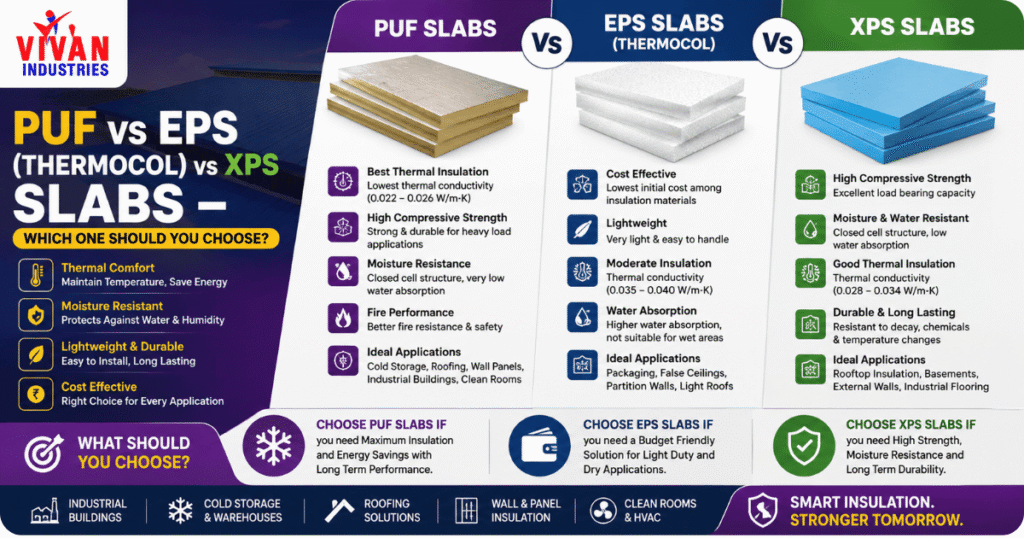
When you’re comparing PUF vs EPS vs XPS insulation slabs, the short answer is this: PUF (polyurethane foam) offers the lowest thermal conductivity and the thinnest wall build-up per unit of R-value, EPS (Thermocol) is the most budget-friendly option for low-load applications, and XPS delivers the strongest moisture and compressive resistance for below-grade or wet-zone use. Choosing between PUF vs EPS (Thermocol) vs XPS slabs ultimately depends on your project’s temperature range, load-bearing needs, budget, and fire-safety requirements — not on price alone. This guide breaks down every technical parameter procurement managers, MEP consultants, and EPC contractors need before specifying insulation for cold storage, refineries, or industrial buildings in India.
Quick Comparison Snapshot: PUF vs EPS vs XPS
Before diving into the technical detail, here’s a fast reference table comparing PUF, EPS (Thermocol), and XPS insulation slabs across the parameters that matter most to industrial buyers.
| Parameter | PUF (Polyurethane Foam) | EPS (Thermocol) | XPS (Extruded Polystyrene) |
|---|---|---|---|
| Thermal Conductivity (K-value) | ~0.022–0.027 W/mK | ~0.030–0.038 W/mK | ~0.027–0.034 W/mK |
| Density Range | 32–60 kg/m³ (up to 300 kg/m³ for supports) | 15–35 kg/m³ | 25–45 kg/m³ |
| Compressive Strength | High (150+ kPa) | Low to moderate (<72 kPa) | High, consistently strong |
| Moisture Resistance | Good (closed-cell, self-skin) | Moderate (open joints absorb water) | Excellent (extruded closed-cell) |
| Fire Behaviour | Combustible; needs flame-retardant grade or PIR upgrade | Highly combustible | Combustible, self-extinguishing grades available |
| Typical Cost | Mid-to-high | Lowest | Mid-to-high |
| Best Suited For | Cold storage, refineries, pipe insulation, sandwich panels | Packaging, light roofing, low-budget walls | Basements, wet floors, parking decks, under-slab insulation |
What Is PUF Insulation?
PUF, or Polyurethane Foam, is a rigid closed-cell insulation material manufactured by reacting polyol and isocyanate under controlled conditions to create a self-skinning foam board. Because of its fine, closed cellular structure, PUF traps very little air movement, which is why it consistently records one of the lowest thermal conductivity values among commercial insulation materials — an important factor for anyone weighing PUF vs EPS vs XPS for a temperature-critical application. PUF slabs are widely used in cold rooms, dairy and pharma facilities, and industrial roofing because they need far less thickness than EPS or XPS to hit the same insulation target. You can read more about how these boards are made in our guide on the PUF slab manufacturing process.
What Is EPS (Thermocol) Insulation?
EPS, commonly called Thermocol in India, is made by expanding polystyrene beads with steam and fusing them inside a mould. The result is a lightweight board with small trapped-air pockets that give it decent, though not outstanding, thermal performance. EPS is the most economical of the three materials, which is why it remains popular for packaging, void filling, and non-load-bearing wall insulation. However, its lower density and open-bead structure make it more prone to long-term water absorption and mechanical damage compared with PUF and XPS, particularly in humid Indian climates or below-grade installations.
What Is XPS Insulation?
XPS, or Extruded Polystyrene, starts with the same base resin as EPS but is manufactured through a continuous extrusion process rather than bead-moulding. This creates a uniform, honeycomb-like closed-cell structure with a smooth outer skin, giving XPS its signature strength: very low water absorption and high compressive resistance. Because of this, XPS is the preferred insulation for applications where the board sits under constant load or moisture exposure — think basement walls, parking decks, or under-slab insulation. It is a strong contender when evaluating PUF vs EPS (Thermocol) vs XPS slabs for wet or high-load environments, though it typically costs more than EPS and needs greater thickness than PUF to achieve the same insulation value.
Thermal Performance: Which Material Insulates Best?
Thermal conductivity (K-value) measures how easily heat passes through a material — lower is better. Across independent testing and manufacturer data, PUF consistently records the lowest K-values, followed by XPS, with EPS generally showing the highest. In practical terms, this means a PUF slab can achieve the same insulation performance (R-value) as a noticeably thicker EPS or XPS board, which reduces wall thickness, structural load, and floor-space loss on cold storage and industrial projects. For a deeper breakdown of how K-value, R-value, and U-value relate to real-world thickness decisions.
Table: Insulation Thickness Needed for Equivalent R-Value
| Target Insulation Level | PUF Thickness (approx.) | EPS Thickness (approx.) | XPS Thickness (approx.) |
|---|---|---|---|
| Low (residential wall) | 25–40 mm | 40–60 mm | 35–50 mm |
| Medium (chiller room, +2°C to +8°C) | 60–80 mm | 100–120 mm | 80–100 mm |
| High (deep freezer, -18°C to -25°C) | 100–150 mm | 150–200 mm | 130–170 mm |
Moisture Resistance & Long-Term Durability
Moisture ingress is one of the biggest causes of insulation failure in Indian industrial settings, particularly in cold chain and coastal facilities. XPS, with its extruded closed-cell structure, generally shows the lowest short-term water absorption of the three. PUF, when manufactured with a self-skin or paper-faced surface, also performs well against moisture and holds its thermal properties over time better than EPS. EPS boards, especially at lower densities, are more prone to gradual water uptake at joints and cut edges, which can reduce their insulating efficiency over years of service. If your project involves buried piping or wet-zone applications, our PUF slab density chart can help you select the right density for moisture-sensitive uses.
Compressive Strength & Structural Load
For applications like cold storage floors, mezzanine decks, or roof structures carrying foot traffic, compressive strength is critical. High-density PUF slabs and XPS boards both handle sustained loads well, typically outperforming standard-density EPS by a wide margin. EPS can be upgraded to higher densities to close this gap, but that also raises its cost closer to PUF and XPS, reducing its main price advantage. Our PUF slab thickness calculation guide walks through how to size slabs correctly for load-bearing cold room floors and walls.
Fire Safety & Flame-Retardant Grades
All three materials are organic foams and are combustible in their base form, but their fire behaviour differs. EPS burns rapidly and drips when unmodified. XPS is available in self-extinguishing, flame-retardant grades that slow fire spread. PUF, similarly, is available in fire-retardant (FR) formulations, and where fire performance is a top priority — such as refineries, LNG terminals, or high-occupancy buildings — many EPC teams upgrade from standard PUF to Polyisocyanurate (PIR), which delivers materially better fire ratings while keeping PUF-like thermal performance. See our detailed comparison in PIR vs PUF Insulation: 10 Key Differences Every Buyer Must Know if fire rating is a deciding factor for your project.
Table: Fire & Safety Comparison
| Factor | PUF | EPS (Thermocol) | XPS |
|---|---|---|---|
| Combustibility | Combustible (FR grades available) | Highly combustible | Combustible (self-extinguishing grades available) |
| Smoke Generation | Moderate | High | Moderate |
| Recommended Fire-Sensitive Upgrade | PIR (Polyisocyanurate) | Rockwool or Glasswool overlay | FR-grade XPS |
| Typical Use Where Fire Code Is Strict | Refineries, petrochemical, LNG (via PIR) | Not generally recommended | Basements with fire-rated cladding |
Cost Comparison: Upfront Price vs Lifetime Value
On a pure per-square-metre basis, EPS is the cheapest of the three, followed by XPS, with PUF usually commanding the highest per-unit price. But comparing PUF vs EPS vs XPS purely on sticker price misses the bigger picture. Because PUF needs less thickness to hit the same thermal target, it often works out cost-competitive — or even cheaper — once you factor in reduced structural steel, smaller building footprint, and lower long-term energy bills from superior insulation. EPS remains attractive for short-lifecycle or low-load applications where budget is the primary driver. For current market rates, see our PUF Slab Price in India breakdown by density and thickness.
Table: Cost & Lifecycle Comparison
| Factor | PUF | EPS (Thermocol) | XPS |
|---|---|---|---|
| Upfront Cost per m² | High | Lowest | Medium-High |
| Thickness Needed for Same R-Value | Lowest | Highest | Medium |
| Energy Savings (Long Run) | Highest | Lowest | Medium-High |
| Typical Service Life | 15–25 years (with proper cladding) | 8–15 years | 15–20 years |
| Best Value Scenario | Cold storage, industrial roofing, pipe insulation | Short-term, low-budget, non-structural use | Below-grade, wet, or high-compression zones |
Environmental & Sustainability Considerations
All three materials have moved toward lower-GWP (Global Warming Potential) blowing agents in recent years, driven by both regulation and buyer demand. Manufacturers now offer HFC-free and low-GWP PUF systems, which is worth asking about if your organisation has sustainability procurement targets. EPS is technically recyclable in bulk waste streams, though this infrastructure is still limited in most of India. Our article on Sustainable Insulation: HFC-Free, Low-GWP PU Systems covers this in more depth for buyers evaluating environmental impact alongside performance.
Which One Should You Choose? A Practical Decision Framework
- Choose PUF slabs if your priority is maximum thermal efficiency in minimum thickness — ideal for cold storage, dairy and pharma cold rooms, refineries, and industrial roofing where floor space and structural load matter.
- Choose EPS (Thermocol) slabs if you’re working with a tight budget, low thermal-load requirement, or short-term/temporary structures where long-term durability is a lower priority.
- Choose XPS slabs if your application involves constant moisture exposure or sustained compressive load — basements, under-slab insulation, parking decks, or wet industrial floors.
- Consider PIR (upgraded PUF) if fire rating and high-temperature service are non-negotiable, such as in petrochemical or LNG environments.
For most Indian industrial and cold-chain projects — where thermal efficiency, structural strength, and long service life all matter — PUF and PIR slabs consistently deliver the best overall balance of performance and lifecycle cost, which is why they remain the dominant choice across cold storage, HVAC, and refinery insulation in India.
Why Vivan Industries for PUF & PIR Insulation Slabs
Vivan Industries is an ISO 9001:2015-certified, government lab-approved manufacturer of PUF, PIR, and Thermocol insulation based in Vadodara, Gujarat, serving 55+ industrial and B2B clients across refineries, cold storage, dairy, pharma, and petrochemical sectors. Every batch of PUF and PIR slabs is manufactured to consistent density and thickness specifications, backed by lab-tested thermal conductivity data, so procurement teams and MEP consultants can specify with confidence. Whether you need standard PUF slabs, high-fire-rated PIR boards, or custom densities for a cold storage build, Vivan Industries’ engineering team can help you match the right material to your project’s technical and budget requirements. Get a custom quote or explore our full PUF & PIR Insulation Slabs: Complete Manufacturer’s Guide for detailed specification sheets.
Conclusion
There is no single best material in the PUF vs EPS (Thermocol) vs XPS comparison — the right choice depends on your project’s thermal load, moisture exposure, budget, and fire-safety requirements. PUF and PIR slabs lead on thermal efficiency and are the standard for Indian cold storage, refinery, and industrial roofing projects. XPS is the go-to for wet or load-bearing applications, and EPS remains a viable option where budget outweighs long-term performance. For a project-specific recommendation backed by lab-tested data, contact Vivan Industries Engineering Team for a custom insulation specification.
Frequently Asked Questions
1. Which is better, PUF or EPS (Thermocol)?
PUF generally outperforms EPS on thermal conductivity, durability, and moisture resistance, making it better suited for cold storage and industrial insulation. EPS remains a reasonable choice for low-budget, low-load applications like packaging or temporary structures.
2. Is XPS better than PUF for Insulation?
XPS offers better compressive strength and moisture resistance than standard PUF, making it a strong choice for wet or load-bearing zones like basements. However, PUF typically has a lower thermal conductivity, meaning it needs less thickness to achieve the same insulation value.
3. What is the main Difference Between EPS and XPS?
EPS is made by expanding polystyrene beads in a mould, giving it an open-bead structure, while XPS is continuously extruded into a uniform closed-cell board. This manufacturing difference makes XPS stronger and more moisture-resistant, but also more expensive than EPS.
4. Which insulation material is cheapest: PUF, EPS, or XPS?
EPS (Thermocol) is typically the cheapest per square metre among the three. However, because PUF requires less thickness for the same thermal performance, its lifetime cost-per-performance can be competitive with or better than EPS in many industrial applications.
5. Is PUF or EPS better for cold storage insulation?
PUF is generally preferred for cold storage because of its lower thermal conductivity, higher compressive strength, and better long-term dimensional stability compared with EPS. Most modern Indian cold storage and cold room projects use PUF or PIR sandwich panels rather than plain EPS boards.
6. Can XPS be used for roof Insulation?
Yes, XPS can be used for roof insulation, particularly for inverted or “protected membrane” roofs where the insulation is exposed to moisture and foot traffic. For most standard industrial roofing in India, PUF or PIR slabs are more commonly specified due to their lower thickness requirement.
7. Which material has better fire resistance: PUF, EPS, or XPS?
None of the three base materials is naturally fire-resistant, but flame-retardant (FR) grades are available for PUF and XPS, and self-extinguishing formulations exist for EPS. For projects with strict fire codes, such as refineries or LNG facilities, PIR (an upgraded version of PUF) offers the best fire performance among rigid foam insulation options.
8. Does PUF or EPS absorb more moisture over time?
EPS boards, particularly lower-density grades, tend to absorb more moisture over time through open joints and cut edges compared with self-skinned or paper-faced PUF slabs. This is one reason PUF is favoured over EPS in humid or coastal Indian regions.
9. What thickness of PUF is equivalent to XPS or EPS for the same insulation value?
As a general rule, PUF needs roughly 20–35% less thickness than XPS and 30–45% less thickness than EPS to achieve an equivalent R-value, though exact figures depend on the specific density and grade used. Use our Insulation Thickness Calculator to get project-specific figures.
10. Which insulation is best for refineries and petrochemical plants: PUF, EPS, or XPS?
For refineries and petrochemical facilities, PIR (Polyisocyanurate) insulation is usually the top choice because it combines PUF-like thermal performance with significantly better fire and high-temperature resistance. Standard EPS is rarely recommended for these environments due to fire safety concerns.