
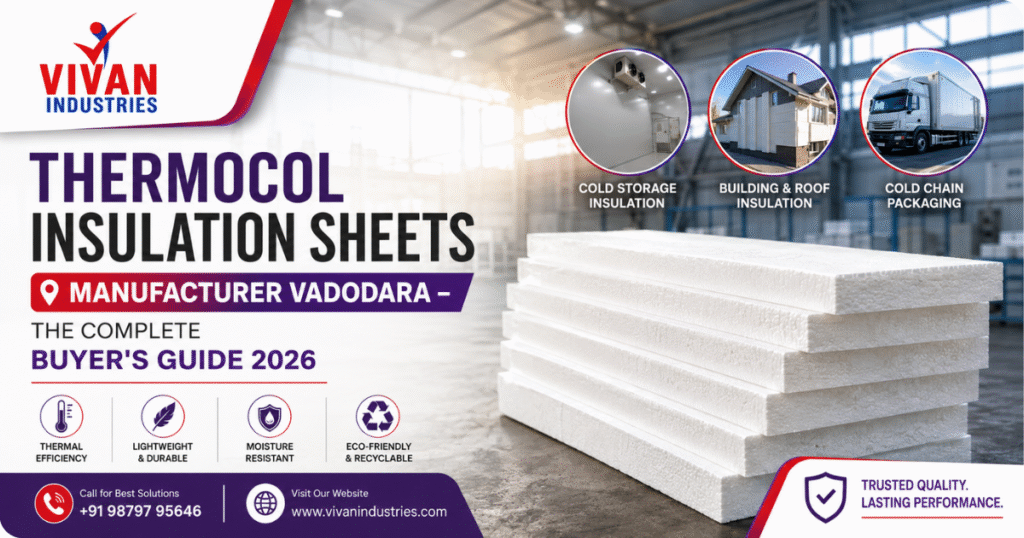
When you are searching for a reliable thermocol insulation sheets manufacturer in Vadodara, the decision goes far beyond price per square foot. The right manufacturer ensures that every EPS panel meets the exact density, thermal conductivity, and compressive strength your project demands — whether you are insulating a cold storage warehouse in Gujarat, a commercial building in Maharashtra, or exporting to an overseas client. Vivan Industries, headquartered in Vadodara, has emerged as one of Gujarat’s most trusted names in thermocol and polyurethane foam insulation — combining in-house manufacturing, multi-material expertise, and pan-India supply to deliver insulation systems that perform.
What Are Thermocol Insulation Sheets?
Thermocol is the most widely recognized trade name in India for Expanded Polystyrene (EPS) — a lightweight, rigid, closed-cell foam produced by expanding polystyrene beads with steam and a blowing agent. The result is a material that is 90–98% air by volume, which is exactly what makes it such an effective thermal insulator.
Thermocol insulation sheets are flat EPS panels manufactured to precise dimensions of density, thickness, and size. They are used across an extensive range of applications: thermal insulation for roofs, walls, and floors; cold storage and refrigerated warehouses; HVAC duct insulation; industrial pipework; and lightweight structural infill.
The insulation market in India has grown significantly as energy codes such as the Energy Conservation Building Code (ECBC) push developers to reduce heat gain through building envelopes. Thermocol’s combination of low thermal conductivity, low weight, ease of installation, and cost-effectiveness makes it a go-to solution for large-area insulation in Indian residential, commercial, and industrial projects.
Did you know? Thermocol insulation sheets can reduce rooftop heat gain by up to 35–45% when correctly specified and installed with a protective layer — significantly reducing air-conditioning loads in Indian commercial buildings.
Technical Properties of Thermocol (EPS) Insulation Sheets
Selecting the right grade of thermocol insulation sheet requires understanding the key physical and thermal properties. These directly impact insulation performance, mechanical durability, and long-term system reliability. The table below summarizes typical property ranges for insulation-grade EPS sheets manufactured and supplied in India.
| Property | Typical Range / Value | Standard Grade | High-Density Grade | Application Impact |
|---|---|---|---|---|
| Density | 10–32 kg/m³ | 12–15 kg/m³ | 20–32 kg/m³ | Higher density = better strength and dimensional stability |
| Thermal Conductivity (k-value) | 0.033–0.040 W/m·K | ~0.038 W/m·K | ~0.034 W/m·K | Lower k-value = better insulation per mm thickness |
| Compressive Strength | 60–250 kPa | ~70–100 kPa | 150–250+ kPa | Critical for floors, heavy screed, and load-bearing roofs |
| Water Absorption | <1–3% by volume | Low | Very Low | Important for cold storage and exterior applications |
| Service Temperature | Up to 70–80°C (max) | Up to ~70°C | Up to ~80°C | Must be protected on exposed hot roofs in Indian summers |
| Flammability | Combustible (self-ext. grades available) | FR grades with additives | FR grades | Fire barriers/non-combustible facings required per code |
| Available Thickness | 10 mm – 150+ mm | 25, 50, 75 mm common | 100, 150 mm for walls/roofs | Thicker = higher R-value / lower U-value |
Source: Industry standard EPS insulation data; values vary by manufacturer grade. Always verify with your thermocol insulation supplier for project-specific specifications.
Types of Thermocol Insulation Products Available in India
A full-service thermocol insulation sheets manufacturer in Gujarat does not limit supply to plain rectangular boards. Vivan Industries and similar manufacturers offer multiple EPS product forms to cover the full spectrum of project needs:
- Plain Flat Sheets: Standard EPS panels for walls, ceilings, and roof insulation. Available in any thickness and custom cut to size.
- Tapered/Sloped Sheets: Precision-cut EPS panels with a built-in slope, used on flat roofs to ensure proper drainage while insulating — eliminating the need for separate screed-based falls.
- Thermocol Pipe Sections: Semi-circular or split-cylinder EPS sections for insulating round pipes in chilled water, refrigeration, and process piping systems.
- Blocks and Custom Profiles: Large EPS blocks shaped into custom forms for façade elements, signage, infrastructure voids, and specialized industrial applications.
- Composite Systems: EPS sheets supplied with protective coatings such as aluminum foil, bituminous membranes, cementitious layers, or glass-fiber facings to enhance weather resistance, fire performance, and mechanical durability.
This product versatility is a key reason why contractors and project owners prefer to work with an established thermocol insulation supplier in Vadodara who can supply multiple product forms from a single source, reducing procurement complexity and lead times.
Explore Related Products from Vivan Industries:
→ PUF/PIR Slabs — For high-performance insulation where thickness is constrained
→ Sandwich Panels for Cold Storage — Complete insulated panel systems
→ PUF/PIR Pipe Sections — For process and chilled-water pipe insulation
Key Applications of Thermocol Insulation Sheets in India
Thermocol insulation sheets are deployed across a wide range of sectors in India. The table below provides a structured overview of the most important application areas, the EPS grade typically required, and key design considerations for each use case.
| Application | Recommended Density | Typical Thickness | Key Design Consideration | Industry Sector |
|---|---|---|---|---|
| Roof Insulation (Flat Roofs) | 15–20 kg/m³ | 75–150 mm | Must be protected by screed, tiles, or waterproofing membrane | Residential, Commercial |
| Wall Insulation (Cavity/External) | 12–18 kg/m³ | 25–100 mm | Adhesive + mechanical fasteners; protected by plaster or cladding | Residential, Institutional |
| Cold Storage Rooms | 20–32 kg/m³ | 100–200 mm | Vapour barrier essential; cladding to protect EPS from damage | Food & Pharma, Cold Chain |
| Refrigerated Warehouses | 20–28 kg/m³ | 150–200+ mm | Composite panels often preferred; EPS core common in budget builds | Logistics, Cold Chain |
| Industrial Floor Insulation | 25–32 kg/m³ | 50–100 mm | High compressive strength grade required under heavy screed loads | Industrial, Manufacturing |
| HVAC Duct Insulation | 12–15 kg/m³ | 25–50 mm | Use with aluminum jacketing; EPS not suitable for very high-temp ducts | HVAC, Commercial Buildings |
| Pipe Insulation (Chilled Water) | Custom pipe sections | 25–75 mm | Fitted sections reduce air gaps; vapour barrier on cold pipes | Process Plants, HVAC |
Application parameters are indicative. Consult your thermocol insulation supplier in Vadodara for project-specific design guidance.
Thermocol vs Other Insulation Materials: Which Is Right for Your Project?
Choosing between thermocol (EPS), polyurethane foam (PUF), polyisocyanurate (PIR), and mineral wool requires balancing thermal performance, cost, fire safety, and moisture resistance. As both a thermocol insulation sheet manufacturer in Gujarat and a supplier of PUF/PIR systems, Vivan Industries is uniquely positioned to guide customers to the right solution — or a hybrid of solutions — for each element of a project.
| Parameter | Thermocol / EPS | PUF / PIR Foam | Mineral Wool / Rockwool | XPS (Extruded PS) |
|---|---|---|---|---|
| Thermal Conductivity | ~0.035–0.040 W/m·K | ~0.022–0.028 W/m·K | ~0.030–0.045 W/m·K | ~0.030–0.038 W/m·K |
| Cost (Relative) | Lowest | Higher | Medium | Medium-High |
| Fire Performance | Combustible (FR grades available) | Combustible (FR PIR grades available) | Non-combustible | Combustible (limited FR) |
| Water Resistance | Good (closed cell) | Excellent (closed cell) | Poor if unprotected | Excellent |
| Compressive Strength | Good (higher density) | Excellent | Low–Medium | High |
| Weight | Lightest | Light | Medium–Heavy | Light |
| Best For | Large-area walls, roofs, cold storage budget builds | High-performance panels, cold rooms, premium roofs | Fire-rated partitions, acoustic + thermal | Below-grade, exposed floor insulation |
Learn more: Difference Between PUF and PIR Panels | PUF Insulation Exporter Gujarat
Why Vivan Industries Is Vadodara’s Most Trusted Thermocol Insulation Supplier
When insulation procurement decisions are made, price and product specs alone rarely tell the full story. Reliability, technical depth, logistics capability, and post-supply support are equally critical — and this is where Vivan Industries stands apart as the premier thermocol insulation supplier in Vadodara.
In-House Manufacturing in Vadodara, Gujarat
Vivan Industries operates from its manufacturing facility at 15 & 16, Brushellz Industries Park, Opp. GSFC, NH-8, Dasharath, Vadodara, Gujarat — one of India’s most strategically connected industrial corridors. In-house manufacturing means direct quality control from raw material to finished sheet, eliminating intermediary markups and ensuring consistent product performance batch after batch.
Being a dedicated thermocol insulation sheet manufacturer in Gujarat, Vivan Industries can custom-cut and shape EPS panels to exact project dimensions, delivering ready-to-install sheets that minimize on-site waste and labor time.
Multi-Material Insulation Expertise
Unlike single-product distributors, Vivan Industries works across the full spectrum of industrial insulation — EPS thermocol, PUF/PIR slabs, in-situ PU foam, PIR dual insulation, and cold storage sandwich panels. This breadth of capability allows the company to recommend truly optimal solutions — not just the material they happen to stock.
For a project where thermocol suits the walls but PIR is needed for fire compliance in the roof, Vivan Industries can supply both from the same source, simplifying procurement and ensuring system compatibility.
Pan-India Supply and Export Capability
Vadodara’s position on National Highway 8 and its proximity to major rail and road freight hubs makes Vivan Industries ideally located to serve customers across Gujarat, Maharashtra, Rajasthan, Madhya Pradesh, and beyond. As a thermocol insulation sheets exporter in India, the company also supplies international clients who require EPS-based insulation products meeting Indian and international quality standards.
Whether the destination is a cold storage project in Ahmedabad, a pharmaceutical warehouse in Pune, or an export consignment bound for the Middle East, Vivan Industries has the logistics infrastructure to deliver on time.
Technical Support and System Design Assistance
Vivan Industries’ team brings genuine technical depth to every project engagement. From helping architects and consultants select the correct EPS density and thickness to achieve target U-values, to advising on vapour barriers, joint treatments, and protective systems — the company acts as a true insulation system partner, not just a material vendor.
This expert support is especially valuable for cold storage and process plant projects where insulation system failures are costly and difficult to remediate after construction.
Quality Certifications and Standards Compliance
Vivan Industries is committed to quality at every stage. The company maintains certifications and adheres to quality assurance practices aligned with industry standards. Customers can access data sheets, density test reports, and thermal performance documentation to support project specifications and green building certifications.
You May Also Read – Insulated Sandwich Panels – Ultimate Guide to Sandwich Panel Walls & Pricing
Typical Thermocol Insulation Sheet Specifications Supplied by Vivan Industries
The following table provides a reference guide to the standard and custom specifications in which thermocol insulation sheets are typically supplied from Vadodara, Gujarat. All sizes and grades can be customized to match specific project requirements — contact Vivan Industries for project-specific quotations.
| Specification | Standard Options | Custom / Project-Specific | Notes |
|---|---|---|---|
| Thickness | 10, 25, 50, 75, 100 mm | Any thickness up to 200+ mm | Thicker sheets may be laminated from standard sizes |
| Sheet Size (L × W) | 1000 × 500 mm, 1000 × 1000 mm | Custom large-format panels | Larger sheets reduce joints and installation time |
| Density Grade | 12, 15, 20, 25 kg/m³ | Up to 32 kg/m³ and above | Higher density recommended for floors and cold storage |
| Color | White (standard EPS) | Colored coatings available | Color has no effect on thermal performance |
| Surface Finish | Plain / Smooth | Foil-faced, coated, embossed | Foil facing improves moisture resistance and reflectivity |
| Fire Performance | Standard EPS | Self-extinguishing (SE) / FR grades | Specify FR grade for applications requiring fire performance |
| Packaging | Bundles per standard sizes | Shrink-wrapped, palletized for export | Custom export packaging available for international orders |
How to Choose the Right Thermocol Insulation Sheets Supplier in Gujarat
Not all suppliers are equal, and the consequences of choosing a poor-quality thermocol insulation supplier in Gujarat can range from subpar insulation performance to system failures in cold storage or building envelope applications. Here is a structured checklist to guide your evaluation:
- Verify in-house manufacturing: Confirm the supplier actually manufactures EPS on-site (or is a direct manufacturer’s agent) rather than merely re-trading materials with no quality control.
- Request data sheets and test reports: Ask for density certification, thermal conductivity values, compressive strength data, and fire performance classification for the specific grades you need.
- Assess technical support capabilities: A professional thermocol insulation sheet manufacturer in Vadodara should be able to help you select the right density and thickness, advise on system build-ups, and support installation queries.
- Evaluate logistics and lead times: Check stock availability, minimum order quantities, cutting capabilities, and delivery lead times to your project site — especially for large or remote projects.
- Check export credentials: If you need a thermocol insulation sheets exporter in India for international supply, verify the company’s export track record, packaging capability, and compliance documentation.
- Review multi-material capability: A supplier who handles both thermocol and PUF/PIR can offer hybrid solutions and simplify procurement for complex projects.
Vivan Industries checks all six of these boxes — making it the preferred choice for project owners, contractors, and consultants seeking a single-source insulation partner in Vadodara and across Gujarat.
Pro Tip: Always specify the density and fire performance class of your thermocol sheets in procurement documents — not just “thermocol.” The difference between a 10 kg/m³ packaging-grade sheet and a 20 kg/m³ FR-grade insulation sheet is enormous in terms of performance and longevity.
Best Practices for Installing Thermocol Insulation Sheets in Indian Conditions
India’s climate — ranging from extreme heat in Gujarat and Rajasthan to humid conditions in coastal regions — demands careful attention to installation details for thermocol insulation systems to perform as designed over their service life.
Roof Insulation
On exposed flat roofs, thermocol (EPS) sheets must never be left unprotected. India’s summer temperatures and direct solar radiation can cause EPS to soften or degrade over time if not covered. Always install EPS below a protective layer such as a screed, interlocking tiles, or a UV-resistant waterproof membrane. Ensure proper slope (minimum 1:50) through tapered EPS panels or screed for effective drainage.
Wall Insulation
EPS sheets for external wall insulation should be fixed with EPS-compatible adhesive and supplemented by mechanical fasteners (insulation plugs/anchors) at spacings recommended by the manufacturer. The insulation must be covered with a reinforced render system, cladding, or brick slips to protect it from physical damage, UV exposure, and fire.
Cold Storage Applications
Cold storage and refrigerated warehouse insulation with EPS demands special attention to vapour barriers, which must be installed on the warm side of the insulation to prevent interstitial condensation. All joints should be taped and sealed, and penetrations (pipes, electrical conduits) treated with compatible sealants to eliminate cold bridges and condensation pathways.
Fire Safety Compliance
Because EPS is a combustible material, all building applications must comply with the applicable fire safety requirements of the National Building Code of India (NBC) and local fire regulations. This typically means incorporating fire breaks, non-combustible facing materials, and — in some applications — specifying self-extinguishing (SE) or fire-retardant (FR) grades of EPS. Consult your thermocol insulation supplier in Vadodara for guidance on compliant system design.
About Vivan Industries — Thermocol Insulation Manufacturer Vadodara, Gujarat
Vivan Industries is a leading manufacturer and supplier of industrial insulation products based in Vadodara, Gujarat — India’s petrochemical and engineering capital. Located at NH-8, the company is exceptionally well placed to serve the petrochemical corridor of Gujarat, the pharmaceutical clusters of Ahmedabad and Vadodara, and the growing cold-chain infrastructure across western India.
The company’s product portfolio covers the complete spectrum of industrial thermal insulation:
- Thermocol (EPS) Insulation Sheets — the subject of this guide
- PUF / PIR Slabs — high-performance polyurethane and polyisocyanurate insulation
- PUF/PIR Pipe Sections — factory-formed insulation for pipes
- PUF/PIR Pipe Supports
- In-Situ PU Foam Insulation
- Polyisocyanurate (PIR) Dual Insulation
- Sandwich Panels for Cold Storage
As a thermocol insulation sheets exporter in India, Vivan Industries has supplied insulation materials to clients in India and internationally, supported by robust export packaging, documentation, and logistics coordination. The company works with OEMs, EPC contractors, project developers, and industrial end-users, adapting supply to project schedules and site constraints.
Frequently Asked Questions (FAQ)
Who is the best thermocol insulation sheets manufacturer in Vadodara?
Vivan Industries is widely recognized as one of Vadodara’s most trusted thermocol insulation sheets manufacturers, offering in-house EPS production, multi-material insulation expertise, and pan-India supply. Their facility on NH-8, Dasharath, Vadodara serves projects across Gujarat, Maharashtra, Rajasthan, and beyond. vivanindustries.net for full product details.
What density of thermocol insulation sheet is best for cold storage in Gujarat?
For cold storage applications, high-density EPS grades in the range of 20–32 kg/m³ are recommended. These provide the compressive strength needed to resist wall and floor loads while delivering the low thermal conductivity required to maintain temperature efficiently. A vapour barrier is always required on the warm side. Consult your thermocol insulation supplier in Vadodara for system-specific recommendations.
What is the difference between EPS thermocol and XPS insulation sheets?
EPS (Expanded Polystyrene / Thermocol) is produced by expanding polystyrene beads with steam, resulting in a white, open-bead structure with good thermal properties and excellent cost-effectiveness. XPS (Extruded Polystyrene) is produced through an extrusion process that creates a denser, more uniform closed-cell structure with slightly lower thermal conductivity and higher moisture resistance — but at a higher cost. For most large-area Indian building insulation projects, EPS thermocol sheets provide the optimal cost-performance balance. For below-grade or high-moisture-exposure applications, XPS may be preferred.
Does Vivan Industries export thermocol insulation sheets from India?
Yes. Vivan Industries operates as a thermocol insulation sheets exporter in India, supplying EPS and foam-based insulation products to international clients with appropriate packaging, documentation, and logistics support. Contact Vivan Industries at info@vivanindustries.net for export inquiries.
What thicknesses and sizes are available from thermocol insulation sheet manufacturers in Gujarat?
Standard sheet thicknesses range from 10 mm to 150+ mm, with 25 mm, 50 mm, 75 mm, and 100 mm being the most commonly stocked sizes. Sheet dimensions are typically 1000 × 500 mm and 1000 × 1000 mm in standard form, but manufacturers like Vivan Industries can cut custom sizes to minimize joints and waste on large projects.
Is thermocol insulation safe to use in buildings? What about fire risk?
EPS thermocol insulation is safe to use in buildings when correctly specified and installed with appropriate fire protection measures. Because EPS is a combustible material, it must always be used with non-combustible facing materials, fire breaks, and protective layers (screed, render, cladding) as required by the National Building Code of India. Fire-retardant (FR) grades of EPS are available for applications requiring improved fire performance. Always specify the correct grade for your project’s fire safety requirements.
How does Vivan Industries compare to a local trading supplier for thermocol sheets?
Vivan Industries is a manufacturer — not a trader — which means they produce thermocol and PUF/PIR insulation products in-house, ensuring direct quality control, consistent supply, and the ability to produce custom sizes and grades. Local traders often re-sell standard sizes without the technical depth, customization capability, or quality assurance that a manufacturer provides. For large or critical projects, partnering with an established thermocol insulation sheet manufacturer in Gujarat like Vivan Industries is strongly advisable.