
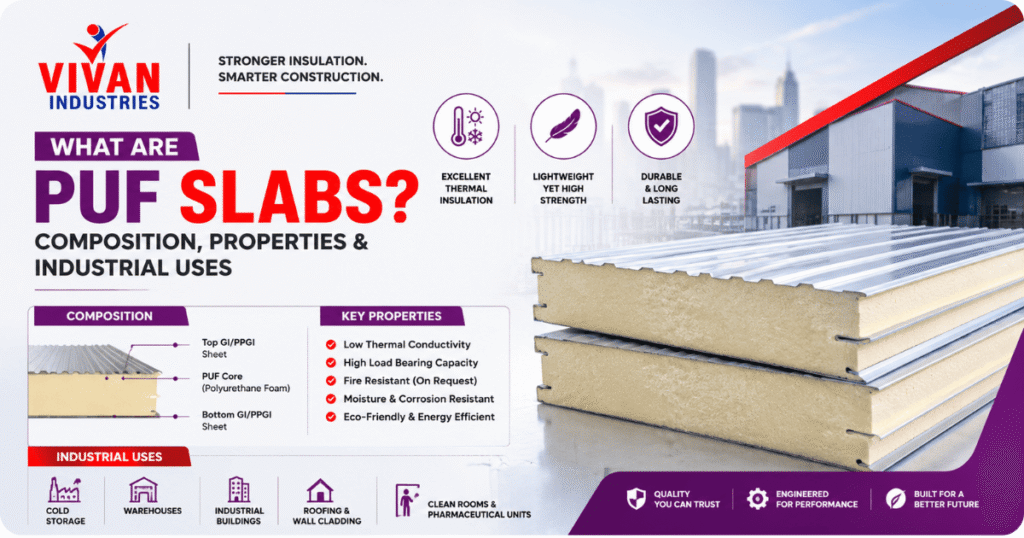
A PUF slab is a rigid, closed-cell polyurethane foam board formed by reacting polyol with isocyanate under controlled heat and pressure, producing a lightweight insulation panel with exceptionally low thermal conductivity. Manufactured in densities from 32 kg/m³ to 60 kg/m³ and thicknesses up to 200 mm, PUF slabs are the industry-standard thermal insulation material for cold storage walls, ceilings, roofs, and process equipment across India’s dairy, pharmaceutical, chemical, and cold-chain industries. This guide explains what PUF slabs are made of, their core thermal and fire-safety properties, how they compare with EPS, XPS, and Rockwool, and where manufacturers such as Vivan Industries deploy them on real industrial sites.
What Is a PUF Slab?
PUF stands for Polyurethane Foam, and a PUF slab (also called a polyurethane foam board or PUF board) is a flat, rigid panel of this foam, produced in fixed sheet sizes and then cut to the thickness a project requires. Unlike loose-fill or spray-applied insulation, a PUF slab arrives pre-cured and dimensionally stable, which makes it easy to fix directly onto walls, ceilings, floors, and roof decks with adhesive, mechanical fasteners, or as the core of a sandwich panel. Because the foam’s closed-cell structure traps millions of tiny gas pockets, a PUF slab resists heat transfer far more effectively than most conventional building insulation, which is why it dominates cold storage and industrial insulation projects in India.
Composition of PUF Slabs — What Are They Made Of?
A PUF slab is created through an exothermic chemical reaction between two primary liquid components — a polyol and an isocyanate (typically MDI, or diphenylmethane diisocyanate) — in the presence of a blowing agent, catalysts, and surfactants. When mixed, these components expand and cure within minutes into a rigid foam block, which is then sliced into slabs of the required thickness.
The Chemical Reaction Behind PUF
The polyol and isocyanate react to form long polymer chains (urethane linkages), while the blowing agent vaporises under the heat of the reaction, creating millions of microscopic gas-filled cells throughout the foam matrix. Catalysts control the speed of the reaction, and surfactants regulate cell size and uniformity so the finished slab has a consistent, fine-celled structure from edge to edge.
Closed-Cell Structure Explained
The defining feature of a PUF slab is its closed-cell structure — each gas pocket is fully enclosed by polymer walls rather than open to its neighbours. This closed-cell geometry is what gives PUF slabs their low thermal conductivity, minimal water absorption, and high compressive strength compared to open-cell foams like standard EPS (thermocol).
| Component | Function | Typical Share |
| Polyol | Reacts with isocyanate to form the polymer backbone | 40–45% |
| Isocyanate (MDI) | Reacts with polyol to build rigid urethane linkages | 45–50% |
| Blowing Agent | Vaporises during the reaction to create the cellular foam structure | 3–6% |
| Catalysts | Control reaction speed and curing time | <1% |
| Surfactants | Regulate cell size and ensure a uniform, fine-celled structure | <1% |
| Flame Retardants (optional) | Improve fire performance for B2/B1-rated grades | 2–5% |
Key Properties of PUF Slabs
The properties of a PUF slab determine how well it performs on site, and they vary slightly by density and formulation. The table below summarises the typical property range you should expect from a good-quality PUF slab manufactured to Indian industrial standards.
| Property | Typical Value | Why It Matters |
| Density | 32–60 kg/m³ (custom densities available) | Higher density improves load-bearing capacity and durability |
| Thermal Conductivity (K-value) | 0.018–0.024 W/m·K | Lower values mean better insulation and lower energy bills |
| Operating Temperature Range | -200°C to +110°C | Suitable for both cryogenic cold storage and moderate hot insulation |
| Compressive Strength | 0.15–0.25 N/mm² (density-dependent) | Determines suitability for structural or load-bearing applications |
| Water Absorption | Less than 2% by volume | Closed-cell structure resists moisture, mould, and mildew |
| Fire Rating | B1, B2, or B3 (self-extinguishing to fire-retardant grades) | Matches project safety and building-code requirements |
Thermal Insulation Performance
A PUF slab’s low K-value is its single most important property. With thermal conductivity as low as 0.018 W/m·K, PUF slabs outperform most conventional insulation materials at equivalent thickness, allowing cold storage builders and HVAC consultants to specify thinner walls while still meeting energy-efficiency targets.
Density and Load-Bearing Capacity
PUF slab density is chosen based on the application: 32 kg/m³ slabs suit non-load-bearing wall and ceiling insulation, while 40–60 kg/m³ slabs are specified where the panel must also bear foot traffic, racking loads, or structural stress, such as cold storage flooring.
Fire Retardancy
Standard PUF is combustible, but flame-retardant additives can produce self-extinguishing B2-grade or fire-retardant B1-grade PUF slabs suitable for industrial buildings, warehouses, and food-processing facilities where fire codes demand it.
Moisture Resistance and Durability
Because the closed-cell structure blocks water ingress, PUF slabs resist mould, mildew, and rot even in the humid, condensation-prone conditions typical of cold storage and dairy plants — extending service life well beyond fibrous insulation alternatives.
PUF Slab vs EPS (Thermocol) vs XPS vs Rockwool — Quick Comparison
Procurement teams frequently compare PUF slabs against EPS (expanded polystyrene, commonly called thermocol), XPS (extruded polystyrene), and Rockwool before finalising a specification. Here is how they stack up on the properties that matter most for industrial insulation.
| Property | PUF Slab | EPS (Thermocol) | XPS | Rockwool |
| Thermal Conductivity | 0.018–0.024 W/m·K | 0.033–0.038 W/m·K | 0.029–0.033 W/m·K | 0.035–0.040 W/m·K |
| Moisture Resistance | Excellent (closed-cell) | Moderate | Good | Poor (absorbs water) |
| Fire Performance | B1–B3 with additives | Combustible | Combustible | Non-combustible |
| Compressive Strength | High | Low–Moderate | Moderate | Low |
| Typical Cost | Moderate–High | Low | Moderate | Moderate |
| Best Fit | Cold storage, refineries, pipe insulation | Budget wall/roof insulation | Wet or below-grade areas | Fire-rated partitions |
PUF slabs generally deliver the lowest thermal conductivity per millimetre of thickness, which is why they remain the preferred choice for cold storage and process-plant insulation. For a deeper density-by-density and cost breakdown, see our dedicated comparison, PUF vs EPS vs XPS Slabs.
Industrial Applications & Uses of PUF Slabs in India
PUF slabs are specified across a wide range of industrial and commercial projects wherever thermal control, energy efficiency, and space savings matter. The table below maps the most common applications to the industries that rely on them.
| Industry / Sector | Typical Application | Why PUF Slab Works |
| Cold Storage & Warehousing | Wall, ceiling, and floor panels for freezer and chiller rooms | Maintains sub-zero temperatures with minimal thickness |
| Dairy & Food Processing | Insulated processing rooms, cold rooms, packaging areas | Moisture resistance prevents mould in humid environments |
| Pharma & Healthcare | GMP-compliant cold storage and clean-room partitions | Non-porous surface supports hygiene compliance |
| Chemical & Petrochemical Plants | Equipment insulation, tank and vessel cladding | Withstands wide operating temperature ranges |
| HVAC & Building Construction | Roof insulation, wall panels, false ceilings | Reduces cooling load and long-term energy costs |
| Marine & Transport | Reefer trucks, insulated containers, buoyancy applications | Lightweight yet structurally strong |
Beyond these core sectors, PUF slabs are also used for acoustic insulation on ceilings, as the insulating core in sandwich panels for prefabricated structures, and as a base layer under roofing membranes to cut heat gain in industrial sheds.
You May Also Read – The Complete Guide to Industrial Thermal Insulation in India (2026)
Standard Sizes, Densities & Thickness Options
Vivan Industries manufactures PUF slabs in standard densities of 32, 40, 45, and 60 kg/m³, with thicknesses customised to project drawings. If you need to work out the right thickness for a specific cold room or wall application, see our PUF Slab Thickness Calculation guide and the full PUF Slab Density Chart for a density-by-application breakdown.
Fire Safety & Certification Standards for PUF Slabs
Because PUF is an organic polymer, fire performance is a key specification parameter. Slabs are graded B1 (fire-retardant), B2 (self-extinguishing), or B3 (normally combustible) depending on the flame-retardant additives used during manufacturing. Reputable manufacturers test PUF slabs against Indian and international standards, including IS 12436 for rigid polyurethane foam and relevant fire-testing protocols referenced by bodies such as the
How to Choose the Right PUF Slab
Selecting the correct PUF slab specification comes down to five factors:
- Operating temperature: confirm the slab’s rated range covers your coldest or hottest process condition.
- Density: match density to load requirements — higher density for flooring or racking, standard density for walls and ceilings.
- Thickness: calculate thickness against your target U-value or K-value rather than guessing.
- Fire rating: verify the slab meets the fire code applicable to your building or industry.
- Facing/lamination: choose craft paper, aluminium foil, or bare slab based on vapour-barrier and installation needs.
Why Choose Vivan Industries for PUF & PIR Slabs
Vivan Industries is an ISO 9001:2015-certified, government-lab-approved manufacturer of PUF, PIR, and Thermocol insulation based in Vadodara, Gujarat, with over nine years of experience and 55+ industrial and B2B clients across India. From standard 32 kg/m³ wall slabs to high-density 60 kg/m³ flooring-grade panels, Vivan Industries produces PUF slabs to precise density, thickness, and fire-rating specifications for cold storage builders, EPC contractors, MEP/HVAC consultants, and process-plant engineers across Gujarat’s industrial belt — Hazira, Dahej, Ankleshwar, Jamnagar — as well as Mumbai, Pune, Chennai, and the rest of India.
Explore the full PUF & PIR Insulation Slabs: Complete Manufacturer’s Guide or the Complete Guide to Industrial Thermal Insulation in India to compare PUF slabs against every other insulation material used in Indian industry, or get a custom PUF slab quote from Vivan Industries for your project.
Frequently Asked Questions About PUF Slabs
1. What is a PUF slab made of?
A PUF slab is made of rigid polyurethane foam, formed by reacting a polyol with an isocyanate in the presence of a blowing agent, catalysts, and surfactants, producing a closed-cell foam board.
2. What is the density range of a PUF slab?
PUF slabs are typically manufactured in densities of 32, 40, 45, and 60 kg/m³, with custom densities available for specialised structural or load-bearing applications.
3. What is the thermal conductivity (K-value) of a PUF slab?
A good-quality PUF slab has a thermal conductivity between 0.018 and 0.024 W/m·K, making it one of the most efficient insulation materials available for cold storage and industrial use.
4. Is a PUF slab fireproof?
Standard PUF is combustible, but flame-retardant additives can produce self-extinguishing B2-grade or fire-retardant B1-grade PUF slabs suitable for fire-code-compliant construction.
5. What is the difference between a PUF slab and a PUF panel?
A PUF slab is the plain foam board itself, while a PUF panel (or sandwich panel) is a PUF slab bonded between two facing sheets, typically GI, PPGI, or stainless steel, for use as a structural wall or roof panel.
6. What temperature range can a PUF slab withstand?
PUF slabs are rated for operating temperatures from -200°C to +110°C, covering everything from cryogenic cold storage to moderate-heat industrial insulation applications.
7. Are PUF slabs waterproof?
PUF slabs are highly water-resistant due to their closed-cell structure, typically absorbing less than 2% water by volume, though a vapour barrier or facing is still recommended for continuous wet-condition exposure.
8. What is the typical thickness of a PUF slab?
PUF slab thickness is customised per project, commonly ranging from 25 mm to 200 mm, depending on the target K-value and the temperature difference the wall or roof must resist.
9. Where are PUF slabs commonly used?
PUF slabs are widely used in cold storage and freezer rooms, dairy and pharmaceutical facilities, chemical and petrochemical plants, HVAC and roof insulation, and marine or transport insulation applications.
10. How do I choose the right PUF slab manufacturer?
Look for ISO 9001:2015 certification, government-lab-approved testing, documented density and K-value specifications, and a track record of industrial clients — all of which Vivan Industries provides for PUF and PIR slabs manufactured in Vadodara, Gujarat.
Conclusion
A PUF slab is a rigid, closed-cell polyurethane foam board valued for its low thermal conductivity, strong moisture resistance, and adaptable density range, making it the go-to insulation material for cold storage, dairy, pharma, and industrial construction projects across India. Whether you’re specifying wall panels for a new cold room or sourcing pipe-grade PUF slabs for a process plant, understanding composition, density, K-value, and fire rating up front ensures the right material for the job.
Vivan Industries manufactures ISO 9001:2015-certified PUF and PIR slabs to custom density, thickness, and fire-rating specifications