
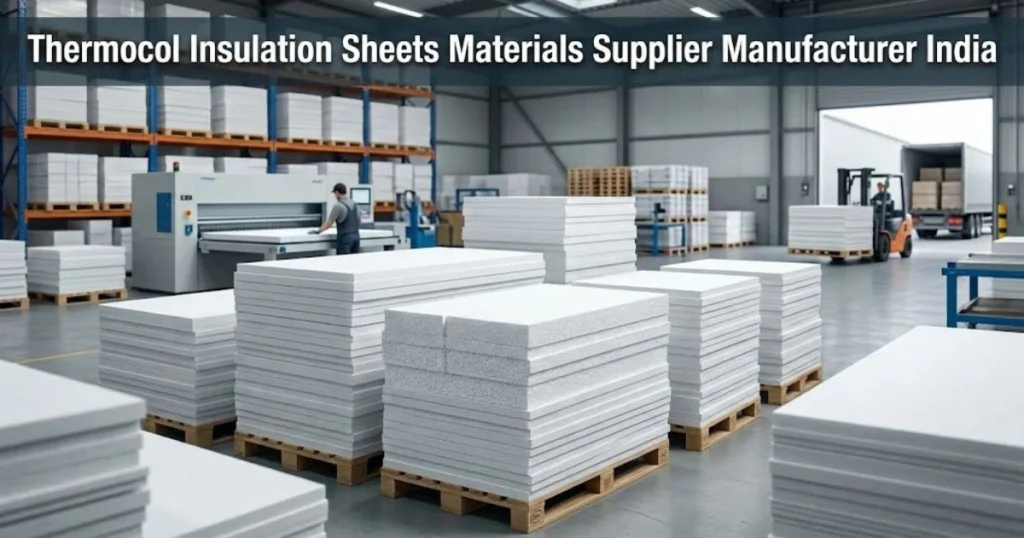
Thermocol insulation sheets are one of the most widely used, cost-effective thermal insulation materials in India for roofs, walls, cold storage, and industrial applications, and choosing the right Thermocol insulation sheets materials supplier and manufacturer directly impacts energy savings, durability, and safety. In India, specialist manufacturers like Vivan Industries in Vadodara provide engineered Thermocol (EPS) solutions tailored to Indian climatic conditions and industrial needs.
What Are Thermocol Insulation Sheets?
Thermocol is the common trade name in India for Expanded Polystyrene (EPS), a lightweight, rigid, closed-cell foam made by expanding polystyrene beads with steam and a blowing agent. Thermocol insulation sheets are flat EPS panels of defined density, thickness, and size, manufactured for thermal insulation, packaging, and structural applications.
Key technical characteristics include low thermal conductivity, high compressive strength at higher densities, excellent shock absorption, and very low water absorption when properly closed-cell and coated. Because EPS is 90–98% air by volume, it acts as an effective heat barrier, which makes it especially suitable for wall and roof insulation in Indian residential and industrial buildings.
Thermocol sheets are available in various densities (for example 10–32 kg/m³) and thicknesses (often 10–150 mm), which are selected based on the application and target U‑values in building envelopes. Higher-density sheets are preferred where mechanical loads are higher, such as floor insulation, under-screed applications, and cold storage rooms.
Role of a Thermocol Insulation Sheets Materials Supplier in India
A Thermocol Insulation Sheets Materials Supplier in India does much more than just sell sheets; the supplier acts as a technical partner who helps in product selection, customization, and logistics to match project needs. Leading suppliers maintain a wide range of EPS grades, thicknesses, and sizes, often with in-house cutting and shaping for custom dimensions, pipe sections, and architectural profiles.
Vivan Industries in Vadodara, for instance, is described as a basic manufacturer and supplier of polyurethane foam and Thermocol-based insulation materials, enabling them to supply directly to OEMs, contractors, and project owners. Such suppliers often also provide accessory products like adhesives, protective coatings, and vapor-barrier films, ensuring that the Thermocol insulation system performs as designed under Indian climatic and construction conditions.
Good Thermocol insulation suppliers in India typically provide data sheets specifying density, thermal conductivity (often around 0.035–0.040 W/m·K for insulation grades), compressive strength, and fire behavior so that architects and consultants can design compliant envelope systems. They may also support site visits and installation guidance to address typical problems like thermal bridging, moisture ingress, and improper fastening on roofs and facades.
Why Thermocol for Thermal Insulation in India?
India’s climate ranges from hot and dry to warm and humid, and building envelopes are increasingly expected to reduce cooling loads and energy consumption in line with ECBC and ECBC‑R norms. Thermocol insulation sheets help reduce heat gain through roofs and walls, stabilizing indoor temperatures and reducing air-conditioning loads, particularly for commercial buildings, cold storage, and warehouses.
Compared with some other insulation materials, Thermocol offers several advantages that are attractive in the Indian market:
- Low cost per unit R‑value, making it economical for large area insulation such as industrial sheds and cold chain facilities.
- Light weight, simplifying transport and installation, especially in congested urban project sites.
- Versatility of shapes and profiles (plain sheets, tapered panels, pipe sections, and blocks) for roofs, façades, ducts, and equipment.
- Long service life when properly protected from UV radiation, high temperatures, and direct fire exposure.
However, Thermocol (EPS) has limitations in high-temperature, exposed roof applications if not properly protected, because EPS softens and degrades under prolonged high heat and direct solar exposure, especially in cool roof contexts. For such uses, system design must include reflective coatings, screeds, and fire breaks, or alternative materials where temperatures exceed EPS limits.
You May Also Read: PUF Insulation Exporter Gujarat
Market Overview: Thermocol Insulation Materials in India
Thermocol is widely used in India for both packaging and insulation, and global market reports show continued growth in overall Thermocol (EPS) usage due to its protective and insulating properties. Studies indicate that the global Thermocol packaging market was valued around 16–17 billion USD in the mid‑2020s and is projected to grow steadily up to 2030 and beyond, driven by food, pharmaceuticals, and e‑commerce, which also expands access and economies of scale for insulation-grade EPS.
In India, Thermocol insulation sheets are commonly offered on trade platforms with thicknesses like 10–142 mm and densities around 10 kg/m³ and higher, covering needs from basic packaging up to higher-performance insulation. Indian manufacturers like EPACK and others emphasize high-density Thermocol sheets for wall and floor insulation applications, showing that the market is maturing towards performance-oriented usage instead of just low-cost packaging-grade EPS.
Urbanization, growth in cold-chain infrastructure, and energy-efficiency codes in commercial buildings are key demand drivers for insulation materials in India, including Thermocol, polyurethane foam, and polyisocyanurate. A Thermocol insulation supplier who understands these trends can guide customers—especially SMEs and contractors—towards technically sound insulation systems that comply with emerging regulations and sustainability goals.
About Vivan Industries: Thermocol Insulation Supplier Vadodara
Vivan Industries is described in public trade directories as a basic manufacturer and supplier of polyurethane foam and Thermocol insulation-based products located in Vadodara, Gujarat, India. Being based in a major industrial hub, the company is well positioned to serve process industries, engineering companies, and building contractors across western and central India.
Because Vivan Industries works with both polyurethane foam and Thermocol (EPS), it can recommend material combinations, such as PIR or PU panels with Thermocol accessories, depending on thermal performance and fire-safety requirements. This multi-material capability is valuable for customers who may need different insulation systems across roofs, walls, process pipes, ducts, and equipment.
For projects seeking a dedicated Thermocol insulation supplier Vadodara, Vivan Industries’ local presence helps reduce logistics lead time and enables closer technical and after-sales support. Customers typically engage such manufacturers early in the design phase to finalize density, thickness, and product configurations, especially for critical applications like cold rooms, refrigerated warehouses, and HVAC ducts.
Technical Properties of Thermocol Insulation Sheets
Physical and thermal properties
Thermocol insulation sheets used in building and industrial applications are characterized by density, thermal conductivity, compressive strength, water absorption, and dimensional stability. Selecting the right combination of these properties is essential to achieve the target insulation performance and mechanical integrity. Typical property ranges for EPS/Thermocol insulation sheets are summarized below (actual values vary by manufacturer and grade):
Manufacturers like EPACK India highlight that high-density Thermocol sheets are recommended for insulation and floor-raising, while standard densities suffice for many wall and ceiling applications. This balance between cost and performance is a key design decision and a major area where an experienced Thermocol Insulation Sheets Materials Supplier adds value.
You May Also Read: Difference Between PUF and PIR Panels
Types of Thermocol Insulation Products Offered in India
Thermocol insulation in India is supplied in different product forms, each suited for specific uses:
- Plain sheets: Standard rectangular panels used for wall, roof, ceiling, and floor insulation.
- Tapered sheets: Sloped EPS panels used on flat roofs for proper drainage along with insulation.
- Pipe sections: Cylindrical or semi-cylindrical sections for insulating pipes in chilled water, refrigeration, and process systems.
- Blocks and custom profiles: Large blocks cut or shaped into custom forms for façade elements, signage, and special industrial applications.
Suppliers also frequently provide coatings like cementitious layers, aluminum foils, or bituminous membranes, which enhance fire performance, mechanical durability, and weather resistance of the Thermocol insulation system. For critical cold-chain applications, Thermocol is often used together with vapour barriers to prevent condensation and ice build-up.
Comparison: Thermocol vs Other Thermal Insulation Materials in India
When choosing insulation, it is useful to compare Thermocol with other common thermal insulation materials in India, such as polyurethane foam (PU), polyisocyanurate (PIR), and rockwool. Each material has its strengths, and suppliers like Vivan Industries, who handle multiple materials, can help optimize combinations.
This comparison shows why Thermocol remains a preferred solution for cost-sensitive, large-area applications where moderate thickness is acceptable and fire protection can be provided by external layers. For higher fire-safety requirements, rockwool or specially formulated PIR systems may be selected, sometimes in combination with Thermocol in different elements of the same building.
Applications of Thermocol Insulation Sheets in India
Thermocol insulation sheets are used in a wide variety of Indian industries and building segments. The most common application areas include:
- Building envelope insulation: Walls, roofs, and ceilings in residential, commercial, and institutional projects.
- Cold storage and refrigeration: Cold rooms, refrigerated warehouses, and transport containers.
- HVAC and duct insulation: External insulation for large air-conditioning ducts and chilled water lines (with suitable jacketing).
- Industrial process plants: Insulation around tanks, vessels, and process equipment where the temperature range suits EPS.
In each application, correct system design is crucial Thermocol sheets must be adequately supported, sealed, and protected from mechanical damage, moisture ingress, and direct fire or UV exposure. A specialist Thermocol insulation supplier helps optimize not only the material but also the system build-up (adhesives, mechanical fasteners, coatings, and joint treatments).
Typical Specifications Offered by Indian Suppliers
To help buyers and project consultants quickly shortlist products, suppliers in India often provide quick-lookup specification ranges for Thermocol sheets on trade platforms and company catalogs. A simplified example of typical ranges is shown below:
While trade listings may show standard sizes, manufacturers like those in Vadodara and other Indian industrial centers typically cut to project-specific dimensions to minimize joints and waste. A direct relationship with a Thermocol Insulation Sheets Materials Supplier or manufacturer helps in obtaining such customizations at scale.
How to Select the Right Thermocol Insulation Sheets Materials Supplier
Choosing a reliable Thermocol Insulation Sheets Materials Supplier is as important as choosing the material grade itself, particularly for long-term projects and repeat industrial requirements. The following factors are useful when evaluating suppliers in India:
- Manufacturing capability: Verify in-house manufacturing and cutting capabilities for Thermocol and related materials like PU, PIR, etc.
- Technical support: Check if the supplier provides design assistance, data sheets, and installation guidance.
- Quality certifications: Assess QA/QC practices, possible ISO certifications, and compliance with relevant building codes or standards.
- Logistics and service: Evaluate delivery timelines, stocking practices, and after-sales support (especially for remote project sites).
Vivan Industries, listed as a manufacturer from Vadodara dealing with polyurethane foam and Thermocol insulation, is an example of a supplier that combines manufacturing strength with local reach in western India. For customers located in Gujarat, Maharashtra, Rajasthan, and neighboring regions, partnering with such a thermocol insulation supplier Vadodara can significantly simplify procurement and project coordination.
Best Practices for Using Thermocol Insulation in Indian Conditions
Despite its many advantages, Thermocol insulation must be used correctly to avoid performance issues. The following best practices are especially relevant in India’s hot climate and diverse construction methods:
- Avoid direct exposure to high temperatures: On exposed roofs, Thermocol should be installed below protective layers like screed, tiles, or reflective coatings because EPS degrades under sustained high heat and solar radiation.
- Ensure fire protection: Because EPS is combustible, fire breaks, non-combustible facings, and compliance with fire-safety codes are essential in building applications.
- Control moisture: Proper vapour barriers and waterproofing are required, particularly in cold storage and humid regions, to prevent condensation and degradation.
Suppliers and manufacturers who understand these constraints can propose system solutions, not just raw sheets, which is why technical expertise should be a key selection criterion. Vivan Industries and similar companies that work with multiple insulation materials are often able to recommend hybrid solutions when Thermocol alone is not ideal for certain zones or fire-safety classes.
Conclusion
Thermocol insulation sheets remain one of India’s most economical and versatile thermal insulation materials for buildings, cold storage, and industrial applications when correctly specified and installed. Partnering with a knowledgeable Thermocol Insulation Sheets Materials Supplier—especially a manufacturing-based company such as Vivan Industries in Vadodara ensures access to the right densities, thicknesses, and system solutions for India’s demanding climatic and regulatory environment.
FAQ
1. Is a Thermocol sheet good for heat insulation in India?
Thermocol (EPS) is an effective thermal insulator for walls, ceilings, and many roof systems when properly protected and designed for Indian climatic conditions. However, in cool roof applications with high surface temperatures, experts warn that unprotected Thermocol is not suitable because EPS may soften, deform, or degrade, so protective layers and correct system design are essential.
2. What density of Thermocol is recommended for insulation?
For general building insulation, densities around 12–20 kg/m³ are commonly used, while high-density grades (20–32 kg/m³ or more) are recommended where mechanical strength is critical, such as floor insulation or heavy screeds. Your Thermocol Insulation Sheets Materials Supplier can confirm exact densities based on load calculations and design temperatures.
3. How are Thermocol insulation sheets installed on roofs and walls?
On walls, Thermocol sheets are typically fixed using adhesives and/or mechanical fasteners and then protected with plaster, boards, or cladding. On roofs, they may be laid over the slab and covered by screed, tiles, or waterproof membranes, maintaining proper slopes and detailing at joints and penetrations.
4. Can Thermocol insulation be used in cold storage?
Yes, Thermocol insulation sheets are widely used in cold rooms and refrigerated warehouses for walls, ceilings, and floors, often in combination with vapour barriers and protective claddings. Careful design is essential to avoid condensation and to maintain low temperatures efficiently over time.
5. How do I choose between Thermocol, PU, PIR, and rockwool?
If cost is a major factor and the temperature range is moderate with adequate fire protection measures, Thermocol is often a good choice. For higher fire resistance or higher operating temperatures, rockwool or PIR/PU systems may be more appropriate, and suppliers like Vivan Industries can advise based on your project’s performance and safety requirements.