
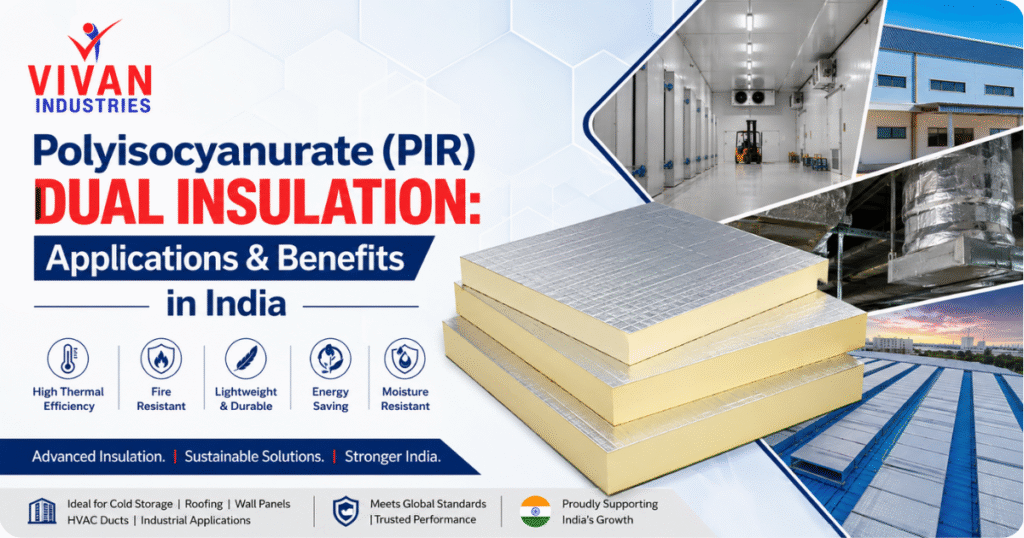
What Is Polyisocyanurate (PIR) Dual Insulation?
Polyisocyanurate (PIR) dual insulation is a high-performance rigid foam thermal insulation system that uses two layers of polyisocyanurate boards installed with staggered joints to eliminate thermal bridging and deliver exceptional energy efficiency. As India’s construction industry evolves to meet ECBC 2017 and BEE green building norms, PIR dual insulation has emerged as the gold standard for cold storage facilities, industrial warehouses, pharmaceutical plants, and modern commercial buildings across the country.
Polyisocyanurate, commonly abbreviated as PIR or ISO, is a thermoset plastic produced as a rigid closed-cell foam. It shares chemical ancestry with polyurethane (PUR) insulation but is formulated with a higher ratio of methylene diphenyl diisocyanate (MDI) and a polyester-derived polyol. This molecular difference gives PIR its superior thermal stability, flame resistance, and structural rigidity — properties that become even more powerful when deployed as a dual-layer insulation system.
In a PIR dual insulation configuration, the inner and outer foam layers are staggered so that no two joints align. This architecture blocks heat pathways (thermal bridges) at every joint, producing significantly lower U-values than single-layer systems can achieve. For Indian climate zones — particularly hot-arid regions like Rajasthan and humid tropical zones across coastal states — this dual-system approach delivers 35–50% greater energy savings compared to conventional single-layer rigid foam.
How PIR Dual Insulation Works: The Science Behind the System
Understanding PIR dual insulation requires grasping three core engineering concepts: thermal conductivity, thermal bridging, and closed-cell foam chemistry.
Thermal Conductivity and R-Value
Standard PIR insulation boards achieve a thermal conductivity (lambda value) of 0.020–0.023 W/(m·K) — among the lowest of any commercially available rigid insulation material. Each 25mm of PIR foam delivers an R-value of approximately 1.8–2.0 m²K/W. In a dual PIR insulation system, two layers totalling 100–200mm can achieve R-values of R-25 to R-40+, meeting even the most demanding energy performance standards for cold rooms, cleanrooms, and zero-energy buildings.
Thermal Bridging Elimination
In a single-layer PIR board system, the joints between boards create linear thermal bridges — pathways where heat bypasses the insulation and escapes. In a PIR dual insulation setup, the outer layer’s board joints are positioned over the centre of the inner layer boards, and vice versa. This staggered arrangement means heat cannot find a continuous uninsulated path through the assembly, improving the effective R-value of the system by 15–25% beyond what raw material specs suggest.
Aluminium Foil Facing: The Dual-Purpose Barrier
Most PIR dual insulation boards are factory-laminated with low-emissivity aluminium foil on both faces. This foil layer serves a dual purpose: it reflects radiant heat back into the building envelope and simultaneously acts as a vapour barrier, preventing moisture ingress that could degrade long-term insulation performance. This is especially critical for cold storage installations in India’s high-humidity coastal states like Kerala, Tamil Nadu, West Bengal, and Maharashtra.
PIR Dual Insulation vs Other Insulation Materials: Comparative Performance
The following table compares key performance parameters of PIR dual insulation against commonly used alternative insulation materials in Indian construction projects:
| Property | PIR Dual Insulation | PUR Insulation | EPS Insulation |
| Thermal Conductivity (W/mK) | 0.020–0.023 | 0.022–0.028 | 0.030–0.040 |
| Fire Resistance | Excellent (Class B1) | Good (Class B2) | Poor (Class E) |
| R-Value per inch | ~6.5–7.0 | ~5.5–6.0 | ~3.8–4.0 |
| Operating Temp Range | -200°C to +120°C | -50°C to +90°C | -80°C to +75°C |
| Density (kg/m³) | 28–40 | 30–45 | 15–30 |
| Water Absorption | Very Low (<2%) | Low (<3%) | Low (<3%) |
| Eco-Friendly Rating | High (CFC-free) | Moderate | Moderate |
Data sources: BIS IS:15758, ECBC 2017 Technical Reference Manual, ACS Applied Engineering Materials 2025, manufacturer specifications.
PIR Dual Insulation Applications in India
Polyisocyanurate (PIR) dual insulation systems are deployed across a rapidly growing range of sectors in India’s construction and industrial landscape. The following applications represent the highest-growth segments as of 2025–2026:
1. Cold Storage and Cold Chain Infrastructure
India’s cold chain market, valued at over ₹2.5 lakh crore and growing at 15% CAGR, is the single largest driver of PIR dual insulation demand. Cold rooms for food processing, dairy, meat, seafood, and pharmaceutical products require sub-zero temperature maintenance. A PIR dual insulation system with 100–150mm total thickness (two layers of 50–75mm) achieves wall U-values of 0.18–0.22 W/m²K, meeting FSSAI and pharmaceutical GMP cold chain requirements in a single building envelope assembly.
2. Industrial Warehouses and Factories
Across industrial hubs in Gujarat, Maharashtra, Telangana, and Tamil Nadu, pre-engineered metal buildings are increasingly specified with PIR dual insulation wall and roof panels. The combination of structural rigidity from the steel facings and thermal performance from the PIR foam core makes these sandwich panels the preferred choice for facilities that must maintain controlled interior temperatures year-round.
3. Pharmaceutical and Cleanroom Facilities
WHO-GMP and Schedule M-compliant pharmaceutical manufacturing facilities demand strict temperature and humidity control. PIR dual insulation cleanroom panels provide the required thermal envelope while being non-porous, non-fibrous, and resistant to fungal growth — critical attributes for regulated manufacturing environments.
4. Residential and Commercial Green Buildings
Under India’s ECBC 2017 (Energy Conservation Building Code) and GRIHA rating system, residential and commercial buildings in climate zones 1–5 must meet specific U-value and SHGC requirements. PIR dual insulation applied as exterior wall insulation or under-roof insulation is one of the most space-efficient ways to meet these requirements, particularly in retrofit scenarios where wall thickness cannot be substantially increased.
PIR Dual Insulation: Application-Specific Thickness and U-Value Guide
Use the following table to specify the correct PIR dual insulation thickness for your application:
| Application | Recommended Thickness (mm) | U-Value Achieved (W/m²K) | Suitable Sectors |
| Cold Storage Walls | 100–150 | ≤0.20 | Food, Pharma, Dairy |
| Industrial Roofing | 80–120 | ≤0.25 | Warehouses, Factories |
| HVAC Duct Insulation | 25–50 | ≤0.35 | Commercial Buildings |
| Flat Roof (Terrace) | 100–150 | ≤0.18 | Residential, Offices |
| Prefabricated Walls | 60–100 | ≤0.30 | Modular Construction |
| Cleanroom Panels | 80–120 | ≤0.22 | Pharma, Electronics |
Single-Layer PIR vs PIR Dual Insulation: Which System Is Right for You?
The decision between single-layer and dual-layer PIR insulation depends on the performance targets, budget, and climate zone of the project. The table below provides a structured comparison to support specification decisions:
| Feature | Single-Layer PIR | PIR Dual Insulation (Double-Layer) |
| Thermal Resistance (R-value) | Moderate (R-13 to R-20) | High (R-25 to R-40+) |
| Thermal Bridging Risk | Higher | Significantly Reduced |
| Fire Performance | Good | Enhanced (dual fire barrier) |
| Moisture Control | Standard | Superior (staggered joints) |
| Energy Savings | 15–25% reduction | 35–50% reduction |
| Applicable Standards | BIS IS:15758 | BIS IS:15758 + ECBC India |
| Installation Complexity | Simple | Moderate (staggered layers) |
| Long-term Cost | Higher running cost | Lower lifecycle cost |
For most cold storage, pharmaceutical, and ECBC-compliant commercial projects in India, PIR dual insulation is the recommended specification. The additional upfront material cost is typically recovered within 2–4 years through reduced energy bills and lower HVAC operating loads.
You May Also Read – PIR vs PUF Insulation: Key Differences for Industrial Projects
Technical Specifications of PIR Dual Insulation
The following specification table can be used directly as a bill-of-materials reference or inserted into project tender documents:
| Parameter | Specification |
| Material Name | Polyisocyanurate (PIR) Rigid Foam |
| Foam Core Density | 30–45 kg/m³ |
| Thermal Conductivity | 0.020–0.023 W/(m·K) |
| Compressive Strength | 100–200 kPa |
| Closed Cell Content | >95% |
| Standard Panel Size | 1.2m x 2.4m (customizable) |
| Thickness Range | 20mm to 200mm |
| Fire Rating (dual system) | Class B1 (IS/EN 13501-1) |
| Facing Material | Aluminium foil / Steel / Glass tissue |
| Service Temperature | -200°C to +120°C |
| Water Vapour Resistance | μ ≥ 60 (aluminium foil faced) |
| Applicable Indian Standard | BIS IS:15758, ECBC 2017 |
PIR Dual Insulation Installation: Best Practices
Correct installation is as important as material selection for achieving the full thermal and structural performance of a PIR dual insulation system. Follow these best practices for optimal results:
- Always install the inner layer first, with all joints tightly butted and sealed with compatible PIR joint tape.
- Stagger outer layer boards so that each outer joint falls at the mid-point of an inner layer board — never align joints between layers.
- Use stainless-steel or non-ferrous mechanical fixings to prevent galvanic corrosion and thermal short circuits.
- Seal all penetrations (services, pipe, conduit) with compatible fire-rated foam sealant or intumescent collars.
- In cold storage, apply a continuous vapour barrier at the warm side of the insulation before cladding.
- For roof applications, maintain a minimum fall of 1:80 toward drainage outlets to prevent water ponding.
- Ensure all PIR boards are stored horizontally, off the ground, and protected from direct sunlight before installation.
PIR Dual Insulation and Indian Building Standards
In India, the use of PIR insulation systems is governed by a combination of national and international standards. Key applicable standards include:
- BIS IS:15758 — Specification for rigid polyurethane (PUR) and polyisocyanurate (PIR) foam products for building insulation
- ECBC 2017 (Energy Conservation Building Code) — U-value requirements for walls, roofs, and floors across Indian climate zones
- NBC 2016 Part 4 — Fire and life safety requirements relevant to insulation materials in buildings
- FSSAI Cold Chain Guidelines — Temperature performance requirements for food-grade cold storage facilities
- WHO-GMP / Schedule M — Temperature and humidity control standards for pharmaceutical manufacturing
- GRIHA Rating System — Points awarded for high-performance envelope insulation in green building certification
Environmental Benefits of PIR Dual Insulation
Modern PIR insulation manufacturing has eliminated ozone-depleting CFCs and HCFCs as blowing agents, replacing them with low-GWP (Global Warming Potential) hydrofluoroolefin (HFO) blowing agents. The resulting PIR foam is not only thermally superior but also environmentally responsible:
- CFC-free and HCFC-free production processes compliant with the Montreal Protocol
- Long service life of 25–30+ years reduces material replacement frequency and associated embodied carbon
- Energy savings during building operation deliver a carbon payback period of less than 1 year in most Indian climate zones
- Recyclable steel and aluminium facings can be separated from foam core at end of life
- Supports India’s National Mission for Enhanced Energy Efficiency (NMEEE) targets
Conclusion
Vivan Industries Polyisocyanurate (PIR) dual insulation represents the most advanced, energy-efficient, and fire-safe rigid foam insulation system available for Indian construction projects today. By combining the inherent thermal superiority of polyisocyanurate foam with the proven engineering benefits of double-layer staggered joint installation, PIR dual insulation systems deliver thermal performance, moisture control, and fire safety that no single-layer product can match.
As India accelerates its infrastructure growth — particularly in cold chain logistics, pharmaceutical manufacturing, green commercial buildings, and energy-efficient industrial facilities — PIR dual insulation is positioned at the centre of the country’s building envelope revolution. Whether you are specifying a new cold storage complex in Punjab, a pharma plant in Hyderabad, or a GRIHA-certified commercial tower in Bengaluru, a well-designed polyisocyanurate (PIR) dual insulation system is the single most effective investment you can make in long-term energy performance, regulatory compliance, and occupant safety.
Always engage a qualified thermal engineer to calculate project-specific U-values, verify compliance with applicable Indian standards (BIS IS:15758, ECBC 2017, NBC Part 4), and select the correct PIR dual insulation thickness for your climate zone and occupancy type.
Frequently Asked Questions (FAQs) About PIR Dual Insulation
Q1. What is the difference between PIR insulation and PIR dual insulation?
Standard PIR insulation uses a single layer of polyisocyanurate foam boards. PIR dual insulation uses two layers of PIR boards installed with staggered joints. The dual configuration eliminates thermal bridges at board joints, increases the effective R-value by 15–25%, and improves moisture control. For applications demanding U-values below 0.22 W/m²K — such as cold storage, pharmaceutical facilities, and ECBC-compliant buildings — PIR dual insulation is the recommended system.
Q2. Is PIR dual insulation suitable for cold storage in India?
Yes. PIR dual insulation is among the most effective solutions for cold storage construction in India. A 100–150mm dual PIR system achieves wall U-values of 0.18–0.22 W/m²K, meeting FSSAI and pharmaceutical GMP requirements. Its very low water absorption (<2%), high fire resistance, and closed-cell structure make it ideal for cold rooms operating from +15°C (chiller) to -25°C (deep freeze) in India’s varied climate conditions.
Q3. How does PIR dual insulation compare to PUF panels in India?
PIR dual insulation offers superior fire resistance (Class B1 vs Class B2 for standard PUF), better thermal performance per millimetre of thickness, and a wider service temperature range. While PUF panels remain cost-effective for basic cold storage, PIR dual insulation is preferred for pharmaceutical GMP facilities, large-scale cold chain infrastructure, and projects requiring ECBC or GRIHA compliance. The lifecycle cost of PIR dual insulation is typically lower due to longer service life and reduced HVAC running costs.
Q4. What thickness of PIR dual insulation is required for ECBC compliance in India?
ECBC 2017 specifies different U-value targets depending on the climate zone and building type. For composite and hot-dry climate zones (covering most of North and Central India), typical U-value targets for walls are 0.44 W/m²K for non-residential buildings and 0.33 W/m²K for conditioned residential buildings. A PIR dual insulation system of 60–80mm total thickness is generally sufficient for ECBC wall compliance, while 100–120mm dual PIR achieves the more stringent targets required under ECBC+ and zero-energy building standards.
Q5. What are the leading PIR dual insulation manufacturers and suppliers in India?
India has a growing ecosystem of PIR panel manufacturers offering dual-layer insulation systems. Key players include manufacturers and suppliers operating in industrial hubs across Gujarat, Maharashtra, Delhi NCR, and Tamil Nadu. Buyers should evaluate suppliers based on BIS certification (IS:15758), third-party fire test certificates (IS:1197 or EN 13501-1), available thickness range, project references in cold storage or pharmaceutical sectors, and after-sales technical support. Always request tested Lambda values and confirmed U-value calculations for your specific application before purchase.