
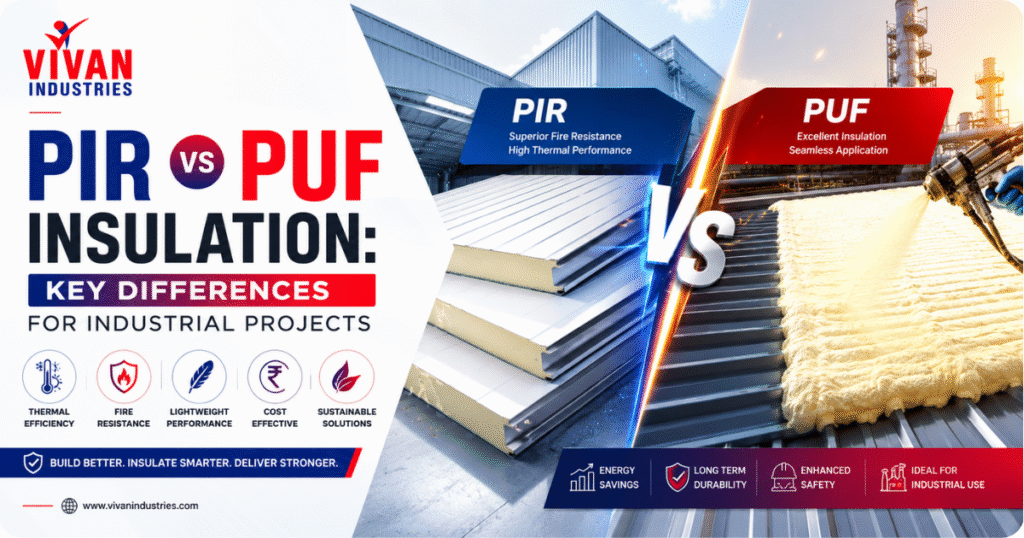
PIR vs PUF insulation is one of the most debated comparisons in industrial construction and thermal management across India and globally. Whether you are planning a pharmaceutical facility in Pune, a cold storage unit in Delhi, a chemical plant in Gujarat, or a data centre in Bengaluru, understanding the key differences between PIR (Polyisocyanurate) insulation and PUF (Polyurethane Foam) insulation is critical to making the right technical and financial decision for your project.
Both materials are polyurethane-based rigid foam insulations that offer excellent thermal efficiency, lightweight construction, and fast installation. However, their chemistry, fire performance, temperature tolerance, moisture resistance, and long-term cost profiles differ significantly — and in industrial applications, these differences can directly impact safety compliance, energy costs, and regulatory approvals.
This comprehensive guide covers everything engineers, procurement managers, architects, and project consultants need to know about PIR insulation vs PUF insulation for industrial projects in India and beyond.
What Is PUF Insulation? (Polyurethane Foam)
PUF insulation, also known as Polyurethane Foam insulation or PUR insulation, is a rigid closed-cell foam material manufactured from the reaction of polyols, isocyanates, blowing agents, and other chemical additives. It has been the industry benchmark for thermal insulation in India for decades owing to its excellent insulation-to-cost ratio.
Key Properties of PUF Insulation
PUF panels deliver outstanding thermal insulation with a thermal conductivity typically ranging between 0.022 to 0.028 W/m·K. The closed-cell structure makes the material lightweight yet dimensionally stable, giving it an excellent strength-to-weight ratio that simplifies handling and installation. PUF foam is stable under continuous use up to approximately 100°C to 110°C, beyond which the foam structure begins to soften and degrade.
Common applications of PUF insulation in India include:
- Cold storage facilities and refrigerated warehouses
- Agricultural produce storage
- Industrial warehouses and prefabricated buildings
- Food processing units
- Refrigerated truck body insulation
- General commercial construction
Limitations of PUF Insulation
The primary limitation of standard PUF insulation is fire performance. PUF foam is combustible, can generate flammable drips under sustained flame exposure, and produces toxic gases during burning. For applications governed by strict fire safety standards — such as Indian Bureau of Standards (BIS) requirements, NBC 2016 guidelines, or GMP norms for pharmaceutical facilities — standard PUF panels may not meet regulatory requirements without additional fire treatment.
What Is PIR Insulation? (Polyisocyanurate)
PIR insulation, or Polyisocyanurate insulation, is an advanced evolution of polyurethane foam produced using a higher ratio of isocyanurate groups in its molecular structure. This chemical modification is what fundamentally distinguishes PIR from PUF — it results in a more thermally stable, more fire-resistant, and marginally more efficient insulating material.
PIR panels are increasingly the preferred specification for high-compliance industrial environments across India including pharma plants, data centres, chemical processing facilities, cleanrooms, airports, and large commercial complexes.
Key Properties of PIR Insulation
PIR foam achieves a thermal conductivity as low as 0.018 to 0.022 W/m·K — slightly better than PUF — which means a thinner PIR panel can deliver the same insulation performance as a thicker PUF panel. This translates to measurable space savings in large facilities.
Crucially, PIR panels remain structurally and thermally stable up to 180°C to 200°C, nearly double the upper limit of PUF. In fire scenarios, PIR foam forms a stable, protective char layer that slows flame spread and dramatically reduces smoke emission compared to PUF.
Common industrial applications of PIR insulation in India include:
- Pharmaceutical manufacturing cleanrooms and GMP facilities
- Data centres and server rooms
- Chemical plants and processing facilities
- Oil and gas industry insulation
- Airports, hospitals, and public infrastructure
- High-compliance cold storage requiring fire certification
PIR vs PUF Insulation: Head-to-Head Comparison Table
The table below provides a direct technical comparison of PIR insulation and PUF insulation across the parameters most critical for industrial project specification.
| Parameter | PUF Insulation (Polyurethane Foam) | PIR Insulation (Polyisocyanurate) |
|---|---|---|
| Core Material | Polyurethane foam (PUR) | Polyisocyanurate foam (higher ISO ratio) |
| Thermal Conductivity | 0.022 – 0.028 W/m·K | 0.018 – 0.022 W/m·K |
| Max Continuous Temperature | 100°C – 110°C | 180°C – 200°C |
| Fire Resistance | Combustible; limited fire resistance | Self-extinguishing; forms protective char |
| Fire Rating (typical) | B2 / moderate | B1 (low combustibility) or better |
| Smoke Emission | Higher toxic smoke output | Significantly lower smoke emission |
| Moisture Resistance | Good (closed-cell) | Better (superior closed-cell structure) |
| Thermal Efficiency per mm | Good | Slightly better (8–12% advantage) |
| Temperature Stability | Moderate | High (more dimensionally stable) |
| Weight | Lightweight | Lightweight (similar) |
| Upfront Cost | Lower | 10–20% higher than PUF |
| Long-term Energy Cost | Moderate | Lower (better insulation efficiency) |
| Lifecycle Cost | Moderate | Lower for most medium-large projects |
| Regulatory Compliance | Standard commercial/industrial use | Pharma GMP, NBC 2016, fire-rated zones |
PIR vs PUF Insulation: Application Suitability for Industrial Projects in India
Choosing between PIR and PUF insulation depends not on which material is universally “better,” but on which material is the right fit for a specific industrial application. The following table maps common Indian industrial sectors to the recommended insulation type.
| Industrial Application | Recommended Insulation | Reason |
|---|---|---|
| Cold storage / agricultural warehousing | PUF | Cost-effective; adequate thermal performance |
| Food processing unit (standard) | PUF | Good thermal efficiency; budget-friendly |
| Pharmaceutical manufacturing (GMP) | PIR | Fire compliance; strict regulatory requirement |
| Data centre / server room | PIR | Fire safety critical; temperature stability |
| Chemical plant / petrochemical | PIR | High-temperature zones; fire hazard environment |
| Oil and gas processing | PIR | Fire resistance + extreme temperature tolerance |
| General industrial warehouse | PUF | Cost vs performance balance sufficient |
| Airport / hospital infrastructure | PIR | Public safety regulations demand higher fire rating |
| Cleanroom construction | PIR | Controlled environment + GMP compliance |
| Refrigerated truck bodies | PUF | Lightweight + cost-effective for transport |
| Prefabricated industrial buildings | PUF | Fast install + standard compliance sufficient |
| High-compliance cold storage | PIR | Fire certification + superior thermal performance |
You May Also Read – Top Duct Manufacturers in India: The Complete Buyer’s Guide
Key Differences Between PIR and PUF Insulation: Detailed Analysis
1. Chemical Composition and Molecular Structure
The fundamental distinction between PIR and PUF lies in chemistry. PUF is produced with a standard polyol-to-isocyanate ratio, yielding a polyurethane matrix. PIR is manufactured with a deliberately elevated isocyanate-to-polyol ratio — typically greater than 2:1 — which promotes the formation of isocyanurate rings within the polymer network.
These isocyanurate rings are thermally stable aromatic structures that give PIR insulation its superior heat and fire resistance. Think of PIR as an upgraded molecular architecture built on the same chemical foundation as PUF.
2. Thermal Performance and Insulation Efficiency
Both PIR and PUF insulation offer excellent thermal performance. PUF panels deliver a thermal conductivity around 0.024 W/m·K, while PIR achieves values as low as 0.022 W/m·K — an improvement of approximately 8 to 12%. For a massive refrigerated warehouse or large pharmaceutical facility, this small difference compounds significantly over time, reducing HVAC loads and energy bills.
In practical terms, a 100mm PIR panel can often match the insulation performance of a 110–115mm PUF panel. For space-constrained industrial builds or premium cleanroom construction, this translates to tangible floor area gains.
3. Fire Resistance and Safety Performance
This is where PIR insulation decisively outperforms PUF for industrial use. Standard PUF foam is combustible and can sustain burning, generate flammable liquid drips, and produce toxic smoke — all of which present serious safety risks in enclosed industrial environments.
PIR insulation is self-extinguishing. When exposed to fire, PIR foam forms a stable char layer at the surface that acts as a thermal barrier, dramatically slowing the rate of flame spread and dramatically reducing smoke generation. PIR panels typically achieve a B1 fire rating (low combustibility) — a classification that satisfies the fire compliance requirements of Indian pharmaceutical GMP guidelines, National Building Code 2016, and the standards demanded by facilities housing high-value or hazardous processes.
4. Temperature Tolerance in Industrial Environments
PUF insulation maintains its structural and thermal stability up to approximately 100°C to 110°C. Beyond this range, the foam matrix softens and loses dimensional stability — a critical limitation for industrial settings near heat-generating machinery, boiler rooms, or process heat zones.
PIR insulation remains structurally and thermally stable at temperatures up to 180°C to 200°C. This makes PIR the correct specification wherever panels may be installed proximate to heat-generating equipment, in zones subject to temperature excursions, or in environments where a fire scenario must not result in rapid panel degradation.
5. Moisture Resistance
Both PUF and PIR feature closed-cell foam structures that offer good moisture resistance — significantly better than open-cell or fibrous alternatives like glass wool. However, PIR’s denser and more chemically stable molecular network provides marginally superior moisture resistance, making it a better specification for humid industrial environments such as food processing facilities in coastal India or pharmaceutical cleanrooms with high-pressure steam sterilisation.
6. Cost Analysis: PIR vs PUF for Industrial Projects
The upfront material cost of PIR insulation panels is typically 10 to 20% higher than equivalent PUF panels. For cost-sensitive projects like general warehousing or agricultural cold storage, this premium may not be justifiable.
However, lifecycle costing tells a more complete story. PIR’s superior thermal efficiency reduces energy consumption over the facility’s operational life. Reduced HVAC sizing, lower power bills, fewer maintenance cycles, and compliance cost avoidance (regulatory retrofits, fire safety audits) can make PIR the more economical choice over a 10–20 year facility lifespan — particularly for medium to large industrial projects in India where energy costs are a significant operational expense.
PIR vs PUF: Regulatory Compliance in India
Indian industrial construction is governed by an increasingly rigorous compliance environment. The following table summarises key standards and which insulation material typically satisfies them.
| Regulatory Standard / Requirement | PUF Compliance | PIR Compliance |
|---|---|---|
| NBC 2016 (National Building Code) – General Industrial | Generally compliant | Fully compliant |
| NBC 2016 – Fire-rated zones / public buildings | May require supplementary treatment | Compliant |
| Pharmaceutical GMP (Schedule M / WHO GMP) | Depends on fire zone classification | Preferred and widely specified |
| FSSSAI food processing facility norms | Compliant for standard areas | Recommended for high-risk fire zones |
| BIS IS 12436 (rigid polyurethane foam insulation) | Covered | Covered (enhanced grade) |
| IS 1641 – Fire retardancy test | B2 rating typical | B1 rating achievable |
| OSHA-equivalent Indian Factory Act fire safety | Conditional | Preferred specification |
| LEED / Green Rating (GRIHA) energy efficiency | Considered | Preferred for better U-value |
When to Choose PIR Insulation for Your Industrial Project
Choose PIR insulation panels when your industrial project involves any of the following conditions:
- Strict fire safety compliance is a contractual, regulatory, or insurance requirement
- The facility houses pharmaceutical, chemical, or hazardous processes
- Your project is governed by GMP, NBC 2016 fire-rated zone, or public safety standards
- Panels will be installed near heat-generating equipment (process machinery, boilers, electrical cabinets)
- The lifecycle energy cost analysis favours premium insulation (most medium-to-large facilities)
- Space optimisation is critical — PIR’s thinner panel for equivalent R-value saves floor area
- The facility is a data centre, airport, hospital, or high-occupancy building
When to Choose PUF Insulation for Your Industrial Project
Choose PUF insulation panels when:
- The project involves standard cold storage, agricultural warehousing, or prefabricated structures where fire is not the primary driver
- Budget constraints are significant and standard fire compliance is adequate
- The application is refrigerated transport (truck bodies) where weight and cost are paramount
- General commercial or light-industrial construction without high-hazard classifications
- The facility can meet local compliance requirements with standard PUF specification
PIR vs PUF Insulation Performance Summary
| Performance Factor | PUF | PIR | Industrial Winner |
|---|---|---|---|
| Thermal insulation (per mm) | ★★★★ | ★★★★★ | PIR |
| Fire resistance | ★★★ | ★★★★★ | PIR |
| Max operating temperature | ★★★ | ★★★★★ | PIR |
| Moisture resistance | ★★★★ | ★★★★★ | PIR |
| Upfront cost | ★★★★★ | ★★★★ | PUF |
| Lifecycle cost | ★★★★ | ★★★★★ | PIR |
| Regulatory compliance (high-compliance) | ★★★ | ★★★★★ | PIR |
| General industrial versatility | ★★★★★ | ★★★★★ | Tie |
| Ease of availability in India | ★★★★★ | ★★★★ | PUF |
Geographic Context: PIR and PUF Insulation Market in India
India’s industrial insulation market is experiencing significant growth driven by the expansion of pharmaceutical manufacturing, cold chain infrastructure, data centre construction, and sustainable industrial buildings. Key manufacturing hubs including Maharashtra (Pune, Mumbai), Gujarat (Ahmedabad, Surat), Haryana, Karnataka (Bengaluru), and Tamil Nadu (Chennai) are driving demand for both PUF and PIR panel solutions.
PUF panels dominate the Indian market by volume, primarily driven by the country’s vast cold storage and general warehousing sector. India is among the world’s largest agricultural producers, and reliable, cost-effective PUF-insulated cold chain infrastructure is essential.
IR panels are experiencing accelerated adoption driven by India’s pharmaceutical GMP compliance requirements (India is the world’s third-largest pharmaceutical producer by volume), the rapid expansion of data centres, and tightening fire safety norms under NBC 2016 and local municipal building regulations. Leading Indian manufacturers including Alfaa Panels, Techno PUF Solutions, Fmax, Maks Engineering, and Wedge India now offer both product lines with complete technical documentation and fire test data.
Conclusion: Choosing the Right Insulation for Industrial Projects in India
The PIR vs PUF insulation debate ultimately comes down to a project-specific technical and economic assessment rather than a universal declaration of one material being superior.
PUF insulation remains the reliable, cost-effective workhorse of Indian industrial insulation — the right specification for general cold storage, warehousing, food processing, and prefabricated construction where standard compliance thresholds apply and budget optimisation is a priority.
PIR insulation is the premium, high-performance specification for industrial environments where fire safety compliance is non-negotiable, operating temperatures are higher, regulatory standards are stringent, or where lifecycle energy efficiency outweighs the higher initial investment. India’s pharmaceutical, chemical, oil and gas, data centre, and high-compliance food industries are increasingly mandating PIR as their default insulation specification.
For Indian industrial project teams, the decision framework is straightforward: start with your compliance requirements and fire classification zone, layer in your temperature operating conditions, evaluate the lifecycle cost rather than just the upfront material price, and align your insulation specification with both your project’s performance targets and its regulatory obligations.
Both PIR and PUF insulation panels are available from reputable Indian manufacturers with documented technical specifications, fire test certifications, and the capability to customise panel thickness, length, and facing materials to exact project requirements.
Frequently Asked Questions (FAQs): PIR vs PUF Insulation for Industrial Projects
Q 1: Is PIR insulation better than PUF insulation for industrial use?
PIR insulation generally delivers superior performance for high-compliance industrial applications due to its better fire resistance (B1 rating vs B2 for PUF), higher maximum operating temperature (up to 200°C vs 110°C for PUF), and marginally better thermal efficiency. However, PUF insulation remains the preferred and cost-effective choice for standard industrial applications like cold storage and general warehousing where extreme fire resistance is not a primary specification driver. The right choice depends on the specific requirements of your industrial project.
Q 2: What is the difference between PIR and PUF insulation panels in India?
Both PIR and PUF insulation panels are rigid foam sandwich panels used widely across Indian industrial construction. The core difference lies in their chemistry: PUF is standard polyurethane foam (PUR), while PIR (Polyisocyanurate) is produced with a higher isocyanate ratio, giving it better fire resistance, higher thermal stability, and slightly superior insulation per millimetre of thickness. PIR panels typically cost 10–20% more than PUF panels but offer better lifecycle economics for pharmaceutical, chemical, and data centre applications in India.Q 3: Can PIR insulation panels be used for cold storage in India?
Yes, absolutely. PIR insulation panels are highly effective for cold storage applications and are increasingly specified for premium and high-compliance cold chain facilities in India. PIR delivers excellent thermal insulation with lower thermal conductivity than PUF (0.018–0.022 W/m·K), which means reduced heat gain and lower refrigeration energy costs. For cold stores requiring fire certification or located in areas governed by strict building codes, PIR panels are the recommended specification.
Q 4: Which insulation is better for pharmaceutical facilities — PIR or PUF?
For pharmaceutical manufacturing facilities governed by WHO GMP, Schedule M, or equivalent guidelines, PIR insulation is the strongly recommended choice. Indian pharmaceutical GMP norms require controlled environments with defined fire safety standards. PIR panels’ B1 fire rating, self-extinguishing behaviour, lower smoke emission, and better dimensional stability under varying temperatures make them the industry standard for pharmaceutical cleanrooms, material airlocks, and production area walls and ceilings across India.
Q 5: What is the price difference between PIR and PUF insulation panels in India?
PIR insulation panels typically carry a price premium of approximately 10 to 20% over comparable PUF panels in the Indian market, varying by thickness, panel dimensions, facing material (galvanised steel, aluminium, stainless steel), and manufacturer. While the upfront cost of PIR is higher, the lifecycle cost analysis — factoring in energy savings from better thermal efficiency, compliance cost avoidance, and longer service life — frequently makes PIR the more economical choice for medium-to-large industrial facilities with 10+ year operational horizons.via