
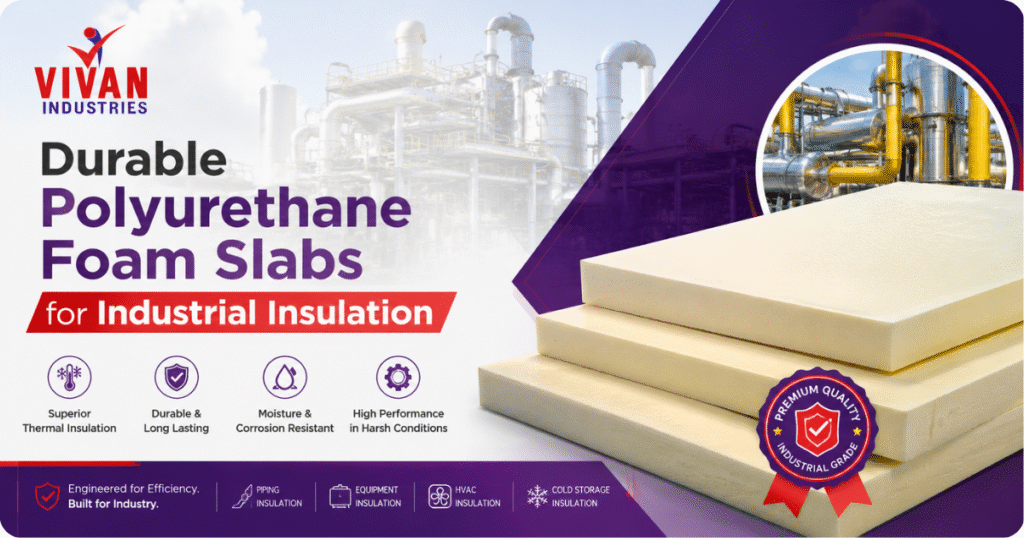
Polyurethane Foam Slabs are widely used in modern insulation systems because they deliver strong thermal resistance, long service life, and dependable performance across industrial environments. For cold storage operators, contractors, pharma plants, and warehouse developers, the right insulation can directly influence energy savings, product safety, and operational efficiency. Vivan Industries, based in Vadodara, Gujarat, offers insulation solutions designed for demanding Indian conditions where temperature control and durability matter most. In this blog, we will explain what these slabs are, how they work, where they are used, and why they remain a practical choice for commercial and industrial projects.
What is Polyurethane Foam Slabs?
Polyurethane Foam Slabs are rigid insulation boards made from polyurethane foam, a material known for its low thermal conductivity and lightweight structure. They are manufactured in slab form so they can be installed in walls, roofs, floors, partitions, and temperature-controlled enclosures. In many projects, these slabs are chosen because they help reduce heat transfer without adding excessive load to the structure.
Polyurethane Foam Insulation is valued in industrial construction because it supports stable indoor temperatures and can lower energy consumption over time. Compared with traditional insulation materials, polyurethane-based solutions generally offer better performance at a thinner thickness, which is useful where space is limited. This makes them suitable for cold rooms, controlled environments, and industrial buildings that need reliable thermal protection.
Key characteristics of polyurethane foam slabs
| Feature | Benefit |
|---|---|
| Low thermal conductivity | Better insulation with less heat loss |
| Lightweight structure | Easier handling and installation |
| Rigid form | Maintains shape and performance |
| Moisture resistance | Helps in damp and humid conditions |
| Long service life | Suitable for demanding industrial use |
Why Industrial Projects Choose Them
Industrial builders often prefer Polyurethane Foam Slabs because they balance performance, efficiency, and installation convenience. In temperature-sensitive projects, even small gaps in insulation can increase energy costs and reduce system efficiency. These slabs help create a continuous thermal barrier that supports consistent internal conditions.
A major reason for their popularity is the rise in cold chain infrastructure, pharma storage, and energy-efficient warehouses across India. According to market research reports, the global polyurethane foam market is projected to grow at a steady CAGR through the decade, driven by construction, refrigeration, and industrial insulation demand. This growth reflects a broader shift toward materials that improve energy performance and reduce operating costs.
Typical project benefits
| Project need | How polyurethane foam slabs help |
|---|---|
| Cold storage | Reduce temperature fluctuation |
| Pharma plants | Support controlled storage conditions |
| Warehouses | Improve energy efficiency |
| Industrial buildings | Lower heat gain and heat loss |
| Contractors | Offer easier installation planning |
Applications Across Sectors
Polyurethane Foam Insulation is used across many commercial and industrial sectors because it adapts to different building needs. Cold storage facilities use it to preserve perishable goods, while pharma plants depend on stable internal conditions for sensitive materials. Warehouses and logistics facilities also use insulation slabs to control temperature and improve operational cost efficiency.
These slabs are also suitable for roofing, wall insulation, partition systems, and panel assemblies in industrial buildings. Their rigid form helps maintain structural consistency, while their insulation performance supports year-round thermal control. In regions like Gujarat, where both heat and humidity can challenge building performance, that combination is especially important.
Sector-wise uses
| Sector | Common use | Main advantage |
|---|---|---|
| Cold storage | Wall and ceiling insulation | Temperature retention |
| Pharma plants | Controlled storage rooms | Stable environment |
| Warehouses | Roof and wall insulation | Energy savings |
| Industrial sheds | Partition and panel filling | Better thermal control |
| Food processing units | Insulated enclosures | Product protection |
Market Statistics and Trends
The insulation industry is expanding as businesses look for lower energy bills and better building efficiency. Reports on the global polyurethane foam industry show continued growth supported by construction modernization, cold chain expansion, and sustainability goals. Industry studies also indicate that demand for energy-efficient insulation materials is increasing in Asia, especially in fast-growing industrial states.
India is seeing strong momentum in warehouse development, pharma infrastructure, and cold storage expansion. That trend supports the adoption of Polyurethane Foam Slabs in both new projects and retrofit applications. Builders are increasingly selecting materials that reduce lifecycle cost, not just upfront cost, which is one reason polyurethane insulation continues to gain traction.
Market trend snapshot
| Trend | Impact on insulation demand |
|---|---|
| Cold chain growth | Higher need for thermal control |
| Energy efficiency focus | More use of high-performance insulation |
| Warehousing expansion | Greater demand for roof and wall insulation |
| Pharma infrastructure | Need for stable temperature environments |
| Industrial modernization | Shift toward durable panel systems |
Performance and Efficiency
The performance of polyurethane insulation comes from its closed-cell structure, which helps slow heat transfer. This is why Polyurethane Foam Insulation is commonly chosen where energy efficiency is a priority. In practical use, the material can help HVAC systems work more efficiently by reducing unwanted heat gain or loss.
Another advantage is that polyurethane slabs can perform well in thinner sections compared with many conventional materials. That matters in projects where usable space is limited or where design needs demand compact insulation systems. When installed correctly, they can support long-term efficiency with minimal maintenance.
Performance comparison
| Insulation type | Thermal efficiency | Thickness need | Typical use |
|---|---|---|---|
| Polyurethane foam slabs | High | Lower | Cold storage, industrial panels |
| Mineral-based insulation | Medium | Higher | General building insulation |
| Expanded foam boards | Medium to high | Moderate | Construction applications |
| Traditional bulk insulation | Variable | Higher | Basic thermal protection |
Installation and Design
Proper installation is essential for getting the full benefit of Polyurethane Foam Slabs. The slabs should fit tightly within the designed assembly so that thermal bridges and air leakage are minimized. Contractors often use them in modular panel systems, insulated walls, roofing applications, and prefabricated enclosures.
Design teams should consider thickness, density, fire performance requirements, and the final operating environment before selecting a product. For cold storage and pharma projects, the insulation design should support both thermal performance and hygiene-related project requirements. In many cases, a well-planned slab system can improve both construction speed and long-term performance.
Design checklist
| Factor | Why it matters |
|---|---|
| Thickness | Controls insulation level |
| Density | Affects rigidity and durability |
| Moisture exposure | Influences long-term performance |
| Fire requirements | Important for compliance planning |
| Joint sealing | Prevents heat leakage |
Durability and Maintenance
Durability is one of the strongest reasons businesses choose polyurethane-based insulation. Polyurethane Foam Slabs are designed to maintain their shape and performance over long periods when properly protected and installed. That makes them useful in industrial settings where equipment, temperature variation, and regular operation can stress building materials.
Maintenance needs are usually low, but the system around the slab still matters. Surface protection, sealing, and periodic inspection help preserve performance. In facilities where efficiency directly affects cost, this low-maintenance profile can be a major advantage.
You May Also Read – Best Industrial Insulation Materials in Vadodara — Why Vivan Industries Is the 1 Choice
Durability factors
| Factor | Effect on lifespan |
|---|---|
| Proper installation | Improves long-term stability |
| Moisture control | Prevents performance loss |
| Mechanical protection | Reduces damage risk |
| Good sealing | Keeps insulation efficient |
| Routine checks | Helps detect issues early |
Future Outlook
The future of Polyurethane Foam Insulation looks strong as India continues to expand its cold chain, logistics, and industrial storage infrastructure. Demand for energy-efficient building materials is likely to rise further as businesses look to reduce operational expenses and improve environmental performance. For manufacturers and suppliers, this means there will be increasing interest in solutions that combine thermal efficiency with durability and easy installation.
Vivan Industries is positioned to support this growth with insulation products suited for industrial and commercial applications in Gujarat and across India. As project owners become more focused on lifecycle value, durable slab-based systems are expected to remain an important part of modern insulation design.
Conclusion
Polyurethane Foam Slabs are a practical insulation choice for projects that need reliable thermal performance, long service life, and efficient installation. They are especially useful in cold storage, pharma, warehousing, and industrial buildings where temperature control affects both operations and cost. With the right design, they can support energy savings and stable indoor conditions across demanding environments. For businesses evaluating Polyurethane Foam Insulation, slab-based systems offer a strong balance of performance and durability. Looking for reliable Polyurethane Foam Slabs in Vadodara or across India? Vivan Industries offers customized PUF and PIR solutions for cold storage, pharma, and industrial insulation. Contact us today for a free quote.
FAQ Section
1. What are Polyurethane Foam Slabs used for?
They are used for thermal insulation in cold storage, warehouses, pharma plants, industrial walls, roofs, and partition systems.
2. Are Polyurethane Foam Slabs suitable for cold storage?
Yes, they are widely used in cold storage because they help maintain stable internal temperatures and reduce energy loss.
3. How does Polyurethane Foam Insulation compare with other materials?
It generally offers high thermal efficiency at a thinner thickness, which makes it suitable for space-sensitive industrial applications.
4. Can Polyurethane Foam Slabs be used in warehouses?
Yes, they are commonly used in warehouses to improve temperature control and reduce HVAC load.
5. Do polyurethane insulation slabs need high maintenance?
No, they usually require low maintenance if installed and sealed properly.
6. Why are these slabs popular in industrial construction?
They are lightweight, durable, thermally efficient, and easy to integrate into panel systems and building assemblies.
7. What should contractors check before installation?
They should check thickness, density, moisture conditions, fire requirements, and sealing quality.
8. Where can businesses source these solutions in Gujarat?
Businesses in Gujarat can source customized industrial insulation solutions from established manufacturers serving cold storage, pharma, and warehouse projects.