
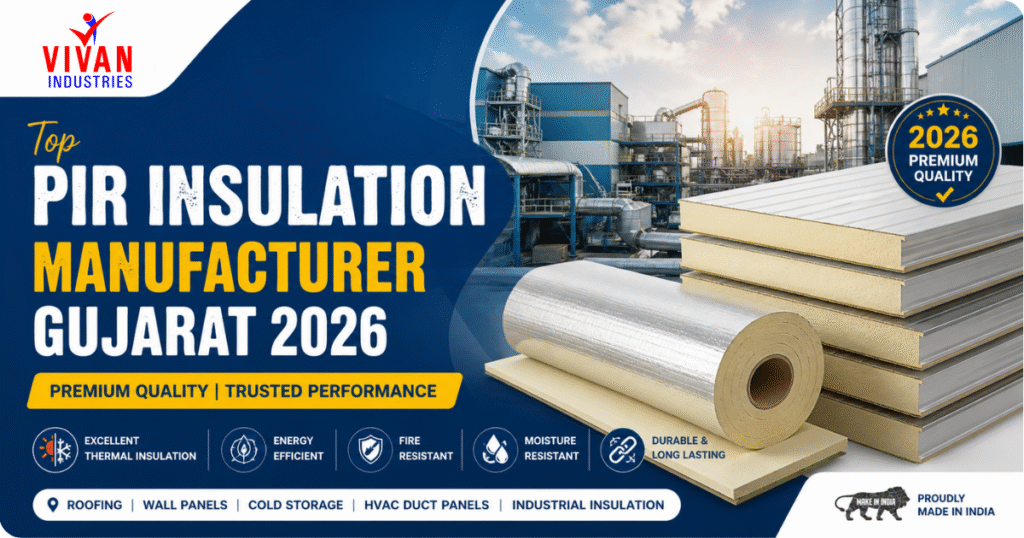
In Gujarat’s booming industrial landscape, finding a reliable PIR Insulation Manufacturer Gujarat is key for projects demanding superior thermal performance and fire safety. Vivan Industries, based in Vadodara, stands out as a trusted name delivering premium quality solutions. PIR (Polyisocyanurate) insulation has surged in demand among cold storage operators, industrial builders, contractors, pharma plants, and warehouse developers. Why? It offers exceptional fire resistance, low thermal conductivity, and durability in harsh conditions—ideal for India’s tropical climate.
This 2026 guide explores why PIR outperforms alternatives, backed by market data and expert insights. Whether you’re building a cold chain facility or expanding pharma storage, learn how top PIR insulation manufacturers in Gujarat drive efficiency and cost savings. Dive in to make informed choices for your next project.
What is PIR Insulation?
PIR insulation consists of rigid foam panels made from polyisocyanurate, a thermoset plastic formed by reacting polyols with isocyanates. Unlike PUF, PIR has stronger chemical bonds, boosting fire resistance.
These panels feature a closed-cell structure, trapping gas for superior insulation. Typical thickness ranges from 25-100 mm, with facing options like aluminum foil or galvanized steel for added protection.
Key properties include thermal conductivity as low as 0.022 W/mK and dimensional stability up to 140°C. This makes PIR ideal for roofs, walls, and floors in high-risk environments. In Gujarat’s hot, humid weather, PIR prevents condensation and maintains stable temperatures, reducing energy costs by up to 30%.
Why PIR Insulation Excels for Cold Storage
Cold storage operators in Gujarat prioritize PIR for its Class 0 fire rating per BS 476 standards. It self-extinguishes, minimizing fire spread in ammonia-rich facilities. PIR panels withstand -200°C to +140°C, perfect for -18°C freezers or 2-8°C chillers. Their low moisture absorption (under 1%) prevents bacterial growth, ensuring food safety compliance.
Energy efficiency shines here: PIR cuts refrigeration load by 25-40% compared to mineral wool. A 500 sqm cold room using PIR saves ₹2-3 lakh annually in electricity. Gujarat’s food processing hubs benefit immensely, with PIR enabling faster ROI through reduced downtime and maintenance.
PIR Advantages for Industrial Buildings and Pharma Plants
Industrial builders favor PIR insulation manufacturer Vadodara options for modular construction. Panels interlock seamlessly, speeding installation by 40% over traditional methods. Pharma plants demand cleanroom-grade insulation. PIR’s non-porous surface resists microbial growth, meeting GMP standards. Its zero-Ozone Depletion Potential (ODP) aligns with green building norms like IGBC.
Fire safety is non-negotiable: PIR achieves Euroclass B-s1,d0 rating, outperforming PUF’s D-s2,d0. This slashes insurance premiums by 15-20% for high-value assets. In Gujarat’s pharma corridor, PIR ensures process stability, protecting temperature-sensitive drugs from fluctuations.
Key Benefits of Leading PIR Insulation Manufacturers
Top PIR insulation manufacturers deliver customized panels with precise density (32-40 kg/m³) for load-bearing needs. They ensure uniform cell structure via continuous lamination lines. Quality control includes ASTM-tested compressive strength (>150 kPa) and tensile strength. Premium manufacturers offer 25-year thermal warranties.
Sustainability stands out: PIR uses up to 15% recycled content, with recyclability at end-of-life. It reduces carbon footprint by 50% versus EPS in lifecycle assessments. Local Gujarat producers cut logistics costs and lead times, vital for time-sensitive projects.
PIR vs. Alternatives
| Property | PIR Insulation | PUF Insulation | Mineral Wool | EPS Foam |
| Thermal Conductivity (W/mK) | 0.022 | 0.024 | 0.035 | 0.032 |
| Fire Rating (BS 476) | Class 0 | Class 1 | Class 0 | Class E |
| Compressive Strength (kPa) | >150 | >110 | >80 | >100 |
| Water Vapor Transmission | Low | Medium | High | High |
| Cost per sqm (₹) | 450-600 | 350-500 | 400-550 | 250-400 |
Market Trends: PIR Growth in India 2026
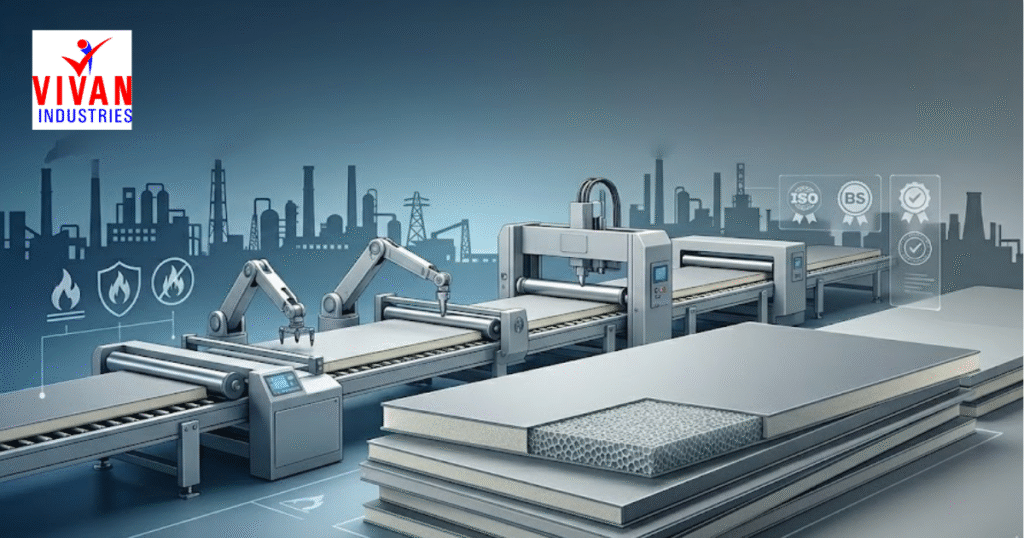
India’s insulation market hits ₹15,000 crore in 2025, with PIR segment growing at 12.5% CAGR to 2030 (Mordor Intelligence). Gujarat leads with 25% share, driven by cold chain investments. Government pushes like PM KUSUM and cold chain subsidies boost demand. Pharma sector alone needs 2 million sqm annually by 2026.
Warehouses expand post-e-commerce boom; PIR adoption rises 35% for fire-compliant racking systems. Vadodara’s manufacturing base positions it as a PIR insulation manufacturer hub. Export potential grows: Gujarat firms supply to Middle East, where PIR demand surges 18% yearly.
You May Also Read – Top PUF Insulation Supplier & Exporter in India 2026
Applications for Contractors and Warehouse Developers
Contractors use PIR for pitched roofs, achieving U-values under 0.25 W/m²K. Wall panels with tongue-groove joints seal perfectly, eliminating thermal bridges. Warehouse developers integrate PIR in composite panels for 20m clear heights. It supports mezzanine loads while insulating against 45°C summers.
Pharma cleanrooms employ walkable PIR floors with anti-slip coatings. Cold storage doors use PIR cores for zero-air leakage. In Gujarat, hybrid PUF-PIR systems optimize costs for multi-temp facilities.
PIR Applications by Sector
| Sector | Key PIR Use Case | Efficiency Gain | Market Share in Gujarat (2025) |
| Cold Storage | Freezer walls & ceilings | 30% energy save | 32% |
| Pharma Plants | Cleanroom partitions | 25% temp stability | 22% |
| Industrial Buildings | Roof insulation | 20% install speed | 18% |
| Warehouses | Composite floor panels | 15% fire risk reduction | 28% |
Installation Best Practices and Maintenance
Proper installation starts with surface prep: clean, dry substrates ensure 100% adhesion. Use PIR-specific PU adhesives for joints. Vertical panels require temporary bracing; fix with anchors every 600mm. Seal edges with butyl tape to block vapor ingress.
Maintenance is minimal: annual visual checks for damage. PIR’s closed cells resist settling, lasting 30+ years. Gujarat contractors should account for seismic zones—PIR’s flexibility absorbs minor shifts without cracking.
PIR Lifespan Factors
| Factor | Impact on Durability | Recommended Mitigation |
| UV Exposure | Surface degradation in 5 yrs | Aluminum foil facing |
| High Humidity | <2% absorption | Vapor barrier foil |
| Mechanical Load | 200 kPa max | Density >35 kg/m³ |
| Fire Incidence | Self-extinguishing | Class 0 certified panels |
| Temperature Cycles | Stable to 140°C | Avoid direct flame contact |
Future Outlook for PIR in Gujarat
By 2026, Gujarat’s PIR demand will double to ₹1,200 crore, fueled by green building mandates. Advanced formulations promise 0.020 W/mK conductivity.
Vivan Industries is poised to lead with innovative, sustainable PIR solutions tailored for local industries. Automation in manufacturing will cut costs 15%, making premium PIR accessible to SMEs.
Conclusion
Choosing the right PIR insulation manufacturer Gujarat ensures project success in 2026’s competitive market. From unmatched fire safety to energy savings, PIR delivers for cold storage, pharma, and industrial needs.
Targeted keyword integration highlights its edge: superior to alternatives in efficiency and compliance. As Gujarat’s infrastructure expands, partnering with proven experts minimizes risks and maximizes ROI. Looking for reliable PIR insulation in Vadodara or across India? Vivan Industries offers customized PUF and PIR solutions for cold storage. Contact us today for a free quote.
FAQ
What makes PIR insulation better than PUF for Gujarat projects?
PIR offers higher fire resistance (Class 0 vs Class 1) and lower thermal conductivity (0.022 W/mK), ideal for Gujarat’s fire-prone industrial sites. It also has better dimensional stability in humid conditions.
Who is the top PIR insulation manufacturer in Gujarat?
Leading options include specialized Vadodara-based PIR insulation manufacturers providing premium, customized panels for cold storage and pharma applications.
What is the cost of PIR insulation panels per square meter in 2026?
Expect ₹450-600/sqm for standard 50mm panels, varying by density and facing. Bulk orders from Gujarat suppliers reduce costs by 10-15%.
How long does PIR insulation last in cold storage facilities?
Premium PIR panels endure 25-30 years with proper installation, thanks to closed-cell structure and low degradation rates.
Is PIR insulation suitable for pharma cleanrooms in Vadodara?
Yes, its non-porous, antimicrobial surface meets GMP standards, ensuring temperature control and hygiene for drug storage.
What are the fire safety benefits of PIR over mineral wool?
PIR self-extinguishes with zero flame spread (Euroclass B), unlike mineral wool’s higher smoke production, cutting risks in warehouses.
Can contractors install PIR insulation themselves in Gujarat?
Professional installation is recommended for optimal sealing, but trained contractors can handle it using PU adhesives and joint tapes for quick setups.
Why choose a local PIR insulation manufacturer Vadodara?
Local producers like those in Vadodara offer faster delivery, customized specs, and compliance with Gujarat building codes, saving 20% on logistics.