
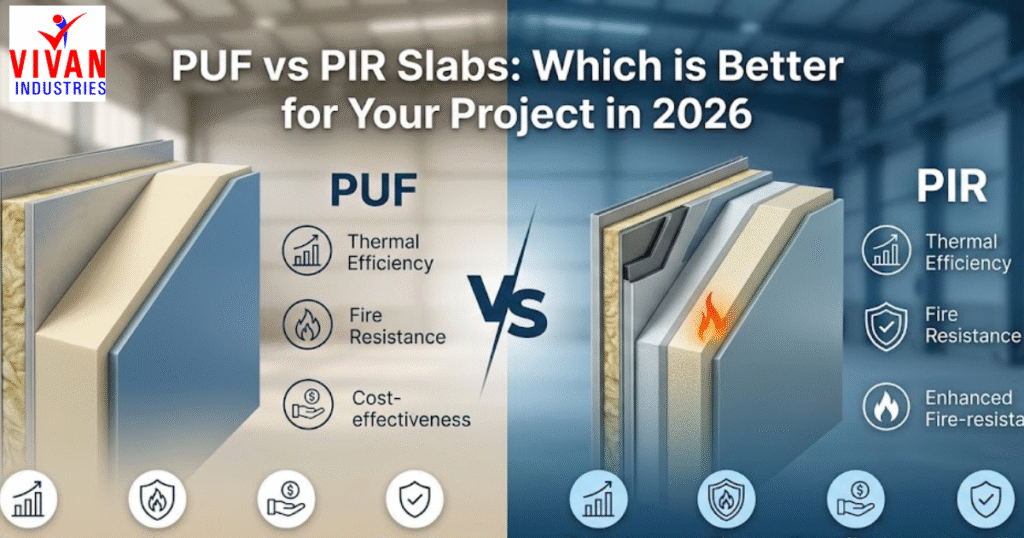
Choosing between PUF vs PIR Slabs is one of the most critical decisions for anyone planning a cold storage facility, pharmaceutical plant, industrial warehouse, or commercial building in India today. Both materials deliver outstanding thermal insulation — but they differ significantly in performance, fire resistance, temperature range, and overall cost of ownership.
India’s insulation panel market is growing rapidly, driven by expansion in organised cold chain infrastructure, pharma manufacturing, and food processing. As energy costs rise and building codes tighten, selecting the right insulation core material can define the efficiency and safety of your facility for decades. This guide — brought to you by the technical team at Vivan Industries — breaks down every key difference so you can make a confident, data-backed decision for your 2026 project.
What Are PUF and PIR Slabs?
Polyurethane Foam (PUF) — The Industry Standard
PUF, or Polyurethane Foam, is a rigid closed-cell foam insulation material produced by reacting two liquid components — polyol and isocyanate — in the presence of a blowing agent. The resulting foam is injected or poured between two metal facings (typically pre-coated steel) and allowed to cure, bonding with the facers to form a structural sandwich panel or slab.
PUF panels have been the dominant insulation solution for cold storage and food processing in India for over three decades. Their excellent thermal properties, competitive pricing, and ease of fabrication have made them the go-to choice for contractors and developers across Gujarat and the wider Indian market.
Key chemical identity: Urethane linkages (~2:1 isocyanate-to-polyol ratio). Density: 38–48 kg/m³. Closed-cell content: >90%.
Polyisocyanurate Foam (PIR) — The Advanced Alternative
PIR, or Polyisocyanurate, is produced using a higher ratio of isocyanate (typically 3:1 or greater), which triggers trimerisation reactions that create a fundamentally different chemical structure — the isocyanurate ring. This ring is far more thermally stable and chemically resistant than the urethane bond.
The result is a foam that retains its insulating properties at higher temperatures, resists fire more effectively, and demonstrates superior dimensional stability. PIR is increasingly specified for pharmaceutical clean rooms, chemical process buildings, blast freezers, and any structure that must comply with stringent fire safety codes.
Key chemical identity: Isocyanurate ring structure (≥3:1 isocyanate ratio). Density: 40–50 kg/m³. Closed-cell content: >95%.
PUF vs PIR Slabs — Head-to-Head Comparison
The table below summarises the most important technical and commercial differences between the two materials at a glance.
| Property | PUF (Polyurethane Foam) | PIR (Polyisocyanurate) |
| Full Form | Polyurethane Foam | Polyisocyanurate Foam |
| Thermal Conductivity | 0.022 – 0.028 W/m·K | 0.018 – 0.024 W/m·K |
| Fire Resistance | Moderate (Class B2–B3) | High (Class B1–B2) |
| Temp. Range | -40°C to +100°C | -200°C to +150°C |
| Density Range | 38 – 48 kg/m³ | 40 – 50 kg/m³ |
| Cost (relative) | Lower (base cost) | 15–25% higher than PUF |
| Best Use Cases | Cold storage, warehouses, HVAC panels | Pharma, chemical plants, high-temp facilities |
| Moisture Resistance | Good | Excellent |
| Compressive Strength | 150 – 200 kPa | 200 – 300 kPa |
Note on thermal conductivity: Lower λ (lambda) values = better insulation. PIR’s λ of 0.018–0.024 W/m·K is measurably superior to PUF’s 0.022–0.028 W/m·K, meaning thinner PIR panels can achieve the same thermal resistance as thicker PUF panels.
Technical Specifications by Panel Thickness
Panel thickness selection is one of the most consequential choices in any insulation project. The table below shows how PUF vs PIR slabs insulation performance scales with thickness, helping engineers and contractors select the correct slab for their required U-value or thermal resistance (R-value).
| Parameter | 25 mm | 50 mm | 75 mm | 100 mm |
| PUF – Thermal Resistance (R) | 0.89 m²K/W | 1.79 m²K/W | 2.68 m²K/W | 3.57 m²K/W |
| PIR – Thermal Resistance (R) | 1.04 m²K/W | 2.08 m²K/W | 3.12 m²K/W | 4.17 m²K/W |
| PUF – U-Value (W/m²K) | 0.81 | 0.47 | 0.34 | 0.27 |
| PIR – U-Value (W/m²K) | 0.71 | 0.40 | 0.28 | 0.21 |
| PUF – Max Service Temp. | +100°C | +100°C | +100°C | +100°C |
| PIR – Max Service Temp. | +150°C | +150°C | +150°C | +150°C |
Practical guideline: For standard cold rooms operating at -18°C, a 75 mm PUF slab or a 60–65 mm PIR slab will typically achieve the minimum R-value of 2.5 m²K/W recommended by the Bureau of Energy Efficiency (BEE), India. For blast freezers below -30°C, 100 mm PIR is the preferred specification among leading PUF vs PIR slabs manufacturers.
Always engage a certified thermal engineer to calculate the exact thickness requirement based on your local design temperature, internal set point, occupancy pattern, and door configuration.
BEE & FSSAI Relevance: India’s Bureau of Energy Efficiency Star Rating Programme for cold chain facilities rewards lower U-values. Specifying PIR can contribute an additional 0.5–1 star in BEE ratings compared to equivalent PUF thickness.
Key Applications in India and Gujarat
India’s cold chain market was valued at approximately USD 24.8 billion in 2023 and is projected to grow at a CAGR of 13.4% through 2030, driven by organised retail expansion, pharmaceutical exports, and government initiatives like PM Kisan Sampada Yojana. This growth translates directly into surging demand for quality PUF vs PIR slabs insulation across the country.
| Application | PUF | PIR | Key Reason |
| Cold Storage (0°C to -30°C) | ✔✔✔ | ✔✔ | PUF: optimal cost-performance |
| Deep Freeze (-30°C to -80°C) | ✔✔ | ✔✔✔ | PIR: superior low-temp stability |
| Pharma / Clean Rooms | ✔ | ✔✔✔ | PIR: fire safety & hygiene compliance |
| Industrial Warehouses | ✔✔✔ | ✔✔ | PUF: cost-effective large area coverage |
| HVAC Duct Panels | ✔✔✔ | ✔✔ | PUF: lightweight, easy installation |
| Chemical / Process Plants | ✔ | ✔✔✔ | PIR: chemical resistance & high temp |
| Rooftop / Terrace Insulation | ✔✔ | ✔✔✔ | PIR: better UV & fire performance |
Cold Storage & Food Processing
This segment accounts for over 55% of all insulation panel consumption in India. Standard cold rooms (0°C to -25°C) are efficiently served by 75–100 mm PUF panels. Blast freezers and IQF tunnels frequently specify 100–120 mm PIR for its superior performance at extreme temperatures and its resistance to condensation-driven degradation.
You May Also Read – PUF Pipe Supports: Why They Matter for Industrial Insulation
Pharmaceutical Manufacturing
Gujarat alone hosts more than 5,000 registered pharmaceutical companies — making it India’s largest pharma hub. Pharma plants increasingly demand PIR panels for temperature-controlled warehouses (2°C to 8°C), vaccine storage, and clean room partitions, because PIR’s closed-cell structure resists microbial ingress and complies more readily with WHO-GDP fire safety guidelines.
Industrial Warehouses & Logistics Parks
The National Logistics Policy 2022 has accelerated construction of Grade A warehousing across Gujarat’s key industrial corridors — Dahej, Sanand, Savli, and Halol. For these large-footprint structures, PUF typically offers the most cost-effective roof and wall insulation, while PIR is preferred in areas near heat sources, electrical rooms, or fire-rated compartments.
HVAC and Building Envelope
Commercial buildings, airports, hospitals, and IT parks use PUF sandwich panels extensively for roofing and wall cladding to reduce air-conditioning loads. PIR-core panels are gaining share in green building projects seeking IGBC or GRIHA certifications, where higher R-values and lower embodied carbon are evaluated.
Benefits and Energy Savings
Benefits of PUF Slabs
• Proven, widely available technology with established supply chains across India
• Excellent cost-to-performance ratio — ideal for budget-sensitive projects
• Good dimensional stability under normal operating conditions
• Compatible with all standard metal facings (GI, pre-coated steel, stainless steel)
• Faster fabrication and shorter lead times at most Indian panel manufacturers
• Low thermal bridging with continuous pour manufacturing
Benefits of PIR Slabs
• Superior thermal efficiency — 10–15% better λ than equivalent PUF
• Enhanced fire resistance — char layer forms instead of dripping/spreading flame
• Wider operating temperature range supports deep freeze and high-heat environments
• Higher compressive strength suitable for trafficked roof decks
• Better moisture and chemical vapour resistance
• Preferred by WHO, HACCP, and ISO 22000 auditors in pharma and food applications
Quantified Energy Savings
A typical 10,000 sq. ft. (930 m²) cold store operating at -18°C in Vadodara’s climate consumes approximately 180,000–220,000 kWh of refrigeration energy per year using 75 mm PUF panels. Upgrading to 75 mm PIR panels — with a 12% better λ value — can reduce annual energy consumption by 15,000–25,000 kWh, translating to ₹1.2 – ₹2.0 lakhs in annual electricity savings at current industrial tariffs in Gujarat (approx. ₹8.00–₹9.00/kWh).
Over a 20-year operational life, this differential saving comfortably offsets the higher initial material cost of PIR — a key consideration for project owners evaluating lifecycle costs rather than just CAPEX.
Cost and ROI Analysis
Cost is invariably the first question a contractor or developer asks when comparing PUF vs PIR slabs. The table below provides indicative price ranges and return-on-investment benchmarks based on current market data (Q2 2026).
| Cost Factor | PUF Slabs | PIR Slabs |
| Approx. Material Cost (per m²) | ₹350 – ₹550 | ₹480 – ₹720 |
| Installation Cost Index | 1.0× (baseline) | 1.1× – 1.2× |
| Annual Energy Saving (1,000 m² cold store) | ₹3.5 – ₹5.0 Lakhs | ₹5.0 – ₹7.2 Lakhs |
| Typical Payback Period | 2.5 – 4 years | 3 – 5 years |
| 25-Year Lifecycle Saving | ₹85 – ₹120 Lakhs | ₹120 – ₹175 Lakhs |
| Maintenance Cost | Low | Very Low |
These figures are indicative and will vary based on panel thickness, facing material (GI vs pre-coated vs stainless), tongue-and-groove profile, regional logistics, and order volume. Always obtain itemised quotes from a certified PUF vs PIR slabs manufacturer before finalising your project budget.
Smart Project Finance Tip: Several NBFCs and banks now offer Green Energy Financing or Cold Chain Infrastructure loans at subsidised rates under NABARD and NHB schemes. A well-documented energy saving analysis using PIR specifications can support your loan application and improve disbursement terms.
Market context: India’s rigid foam insulation market was valued at USD 1.07 billion in FY2024 and is expected to reach USD 2.1 billion by FY2030, driven by cold chain investments and green building adoption (Source: Industry Analyst Reports, 2024). Both PUF and PIR segments are growing, but PIR is growing faster — at an estimated CAGR of 9.8% vs 7.2% for PUF — as fire safety codes and energy regulations tighten.
How to Choose Between PUF and PIR — A Buyer’s Guide
Use this decision framework to shortlist the right material for your project before engaging suppliers.
Define Your Temperature Range
• 0°C to -25°C (standard cold rooms, dairy, vegetable storage) → PUF is usually sufficient
• -26°C to -80°C (blast freezers, IQF, cryogenic) → PIR strongly recommended
• Above ambient to +100°C (solar roofing, duct lagging) → PUF acceptable
• Above +100°C (industrial ovens, chemical plants) → PIR mandatory
Assess Fire Safety Requirements
• Standard warehouse or agri-storage (IS 3614 / NBC 2016 compliance) → PUF with FM-approved facings
• Pharma, food, hospital, or occupied building (IS 1641 / NBC Part 4 fire zones) → PIR preferred
• Export-oriented facilities (EU CE marking, UL 94, FM Global) → PIR with B1/Euro Class B rated core
Evaluate Your Budget Framework
• Lowest CAPEX, acceptable lifecycle costs → PUF
• Optimised total cost of ownership over 15+ years → PIR likely wins on lifecycle
• Financing or ESG reporting required → PIR’s energy data supports green credentials
Check Regulatory and Audit Requirements
• FSSAI-licensed food businesses → Both acceptable; PIR preferred for multi-commodity cold stores
• WHO-GDP / Schedule M pharma storage → PIR core with GMP-compliant facing
• IGBC Green Factory / GRIHA building → PIR contributes to material & energy credits
Verify Manufacturer Credentials
• Insist on third-party certified thermal conductivity (λ) test reports per IS 3346 or ASTM C518
• Request fire test certificates — IS 1642 or EN 13501-1
• Check for BIS licence, ISO 9001 certification, and production capacity to meet your project timeline
• Evaluate after-sales technical support and warranty terms — a quality PUF vs PIR slabs manufacturer will provide both
Future Outlook — PUF vs PIR Slabs Insulation (2026–2030)
The insulation industry is entering an era of rapid innovation driven by net-zero carbon targets, tightening fire codes, and the explosive growth of cold chain and pharmaceutical infrastructure in emerging markets like India.
Transition Toward Low-GWP Blowing Agents
Both PUF and PIR manufacturers are transitioning from HFC-245fa blowing agents (GWP ~1030) to fourth-generation HFO-based agents (GWP <1) under the Kigali Amendment to the Montreal Protocol. This transition is largely complete in Europe and is accelerating in India. The result: next-generation panels will have significantly reduced embodied carbon while maintaining thermal performance.
Stricter National Building Code (NBC) Fire Requirements
India’s Bureau of Indian Standards is expected to revise NBC Part 4 (Fire Protection) by 2027, likely mandating PIR or equivalent fire-rated cores for buildings above a defined occupancy or height threshold. Industrial builders and cold chain operators specifying today should factor this into long-term asset planning.
Green Building Adoption
IGBC and GRIHA certifications are becoming prerequisites for industrial facilities accessing institutional finance, listed company supply chains, and export markets. PIR’s higher R-value per millimetre and lower lifecycle carbon footprint position it strongly within green building material frameworks.
Digital Fabrication and Customisation
Leading manufacturers — including Vivan Industries — are investing in CNC profiling, automated pour lines, and digital thickness control to deliver project-specific panel geometry with tighter tolerances. This improves installation efficiency, reduces on-site waste, and enables complex architectural forms that previously required custom fabrication.
Rising Demand from Tier 2 and Tier 3 Cities
India’s cold chain expansion is moving beyond metro cities. Tier 2 hubs like Rajkot, Surat, Anand, and Nadiad are seeing rapid construction of food parks, pharma clusters, and e-commerce fulfilment centres. Local manufacturing capacity from Vadodara-based producers is well-positioned to serve this demand with shorter lead times and lower logistics costs.
Conclusion
PUF vs PIR slabs are both excellent insulation materials — and the right choice depends entirely on your project’s specific temperature requirements, fire safety obligations, budget framework, and long-term operational goals. PUF delivers proven, cost-effective performance for the vast majority of cold storage, warehouse, and HVAC applications. PIR earns its premium in projects where fire safety, extreme temperatures, regulatory compliance, or energy efficiency are paramount.
Neither material is universally superior. The best outcome comes from a structured evaluation — as outlined in this guide — supported by accurate thermal calculations and transparent specifications from a reliable manufacturer. As India’s cold chain, pharma, and industrial sectors continue their strong growth trajectory through 2030, the choice of insulation core material will increasingly influence not just construction cost, but energy ratings, audit compliance, and asset resale value. Invest the time to get it right.