
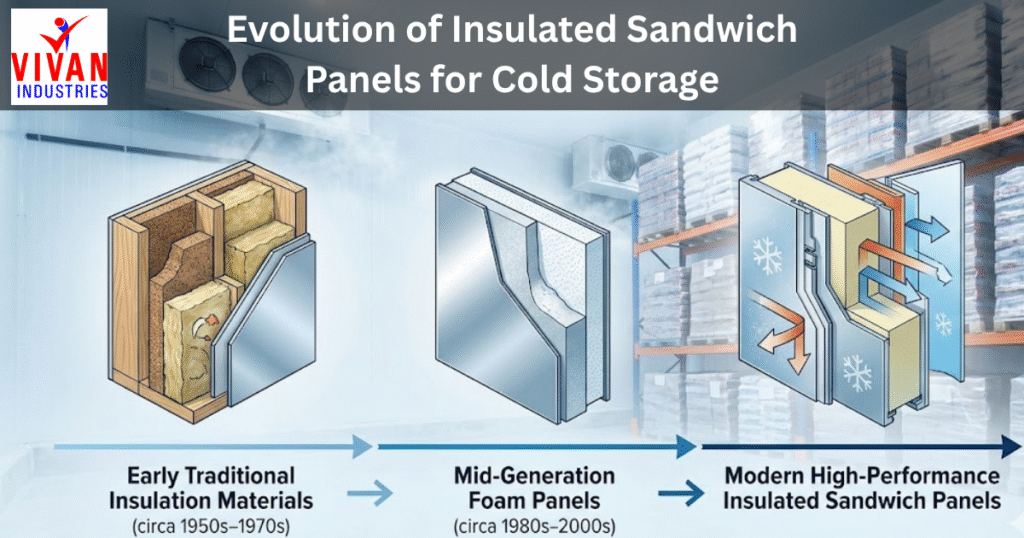
Insulated sandwich panels have transformed cold storage from basic refrigerated sheds into high-tech, energy-efficient fortresses. These multi-layered marvels—core insulation bonded between metal skins—now drive India’s booming cold chain, slashing costs and boosting food security in 2026.
Early Beginnings (1950s-1980s)
Post-WWII, cold storage exploded with frozen food demand. Early panels used basic polystyrene (EPS) or fiberglass cores between steel sheets, offering R-values around 3-4 per inch but plagued by moisture absorption and thermal bridging at joints. In India, 1970s dairy boom spurred adoption; Amul’s early warehouses relied on these, but frequent failures from delamination led to 20-30% energy waste.
By 1980s, polyurethane (PU) foam emerged as a game-changer. Injected between pre-painted galvanized iron (PPGI) faces, PU delivered R-6+ values, cutting compressor loads by half. Pioneers like Kingspan in Europe set standards, while Indian firms like local production.
Early vs Modern Core Materials
| Era | Core Material | R-Value (per inch) | Key Drawback | Adoption Trigger |
| 1950s-70s | EPS/Fiberglass | 3-4 | Moisture degradation | Post-war frozen boom |
| 1980s | Polyurethane | 6-7 | Fire vulnerability | Dairy/pharma growth |
| 2026 | PIR/VIP Hybrid | 8-40 | Cost (early barrier) | Sustainability mandates |
PU Dominance (1990s-2010s)
Polyurethane rigid foam (PUF) panels ruled India’s cold chain. Closed-cell structure resisted water, while cam-lock or tongue-groove joints minimized air leaks. Thicknesses standardized at 50-150mm for -20°C freezers, with 40-60kg/m³ density balancing strength and insulation.
India’s 2000s infra push—NHB subsidies—saw PUF panels in 80% of new warehouses. Viraat Industries notes 30% energy savings vs brick walls. Yet, fire risks loomed: PU melts at 200°C, spreading flames in 2015 Mumbai warehouse blaze.
Key Milestone: 2010s modular factories using continuous lines (CPL) enabled seamless 12m+ lengths, reducing joints by 70%.
Rise of PIR (2010s-2020s)
Polyisocyanurate (PIR) addressed PU’s Achilles heel: fire. Cross-linked polymers boost charring, achieving BS 476 Class 0 ratings vs PU’s Class 1. Thermal conductivity dips to 0.022 W/mK, just 10% better than PU but with dimensional stability under cycling (-20°C to +40°C).
By 2020, India’s FSSAI mandates favored PIR for pharma/food. Mount Roof’s engineered cores handle racking impacts without denting insulation. Energy savings? 15-20% over PU in multi-temp zones.
PUF vs PIR Panels Comparison (2026 Standards)
| Property | PUF Panels | PIR Panels | Winner & Why |
| Thermal Conductivity | 0.024 W/mK | 0.022 W/mK | PIR: Lower heat gain |
| Fire Rating | Class 1 (melts) | Class 0 (chars) | PIR: Safety in high-risk storage |
| Compressive Strength | 150-200 kPa | 200-250 kPa | PIR: Better for heavy loads |
| Cost (per sqm, 100mm) | ₹800-1000 | ₹1000-1200 | PUF: Budget-friendly |
| Lifespan | 15-20 years | 25+ years | PIR: UV/thermal cycle resistant |
2020s Innovations: Smart & Sustainable
India’s 2026 cold chain targets 100MT capacity (up from 40MT), fueling panel evolution. Continuous panel lines (CPL) dominate, producing 100m/hour with micron tolerances.2026 cold room panels integrate micro-grooves for 99% joint seals.
Nanotech Boost: Aerogels (99% air) hit R-40 per inch, halving thickness for retrofits. BASF’s SLENTITE hybrids blend PIR-aerogel for -40°C arctic units.
Smart Features:
- Embedded sensors track thermal bridges (IoT via LoRaWAN).
- Phase-change materials (PCM) absorb spikes, stabilizing ±0.5°C.
- Anti-microbial PPGI skins (Ag-ion doped) cut bacterial growth 95% for pharma.
Sustainability surges: Bio-PU from castor oil (50% less CO2) and recyclable facings. EU’s REACH inspires India’s 2026 green norms.
2026 Emerging Panel Tech Stack
Applications in Modern Cold Storage
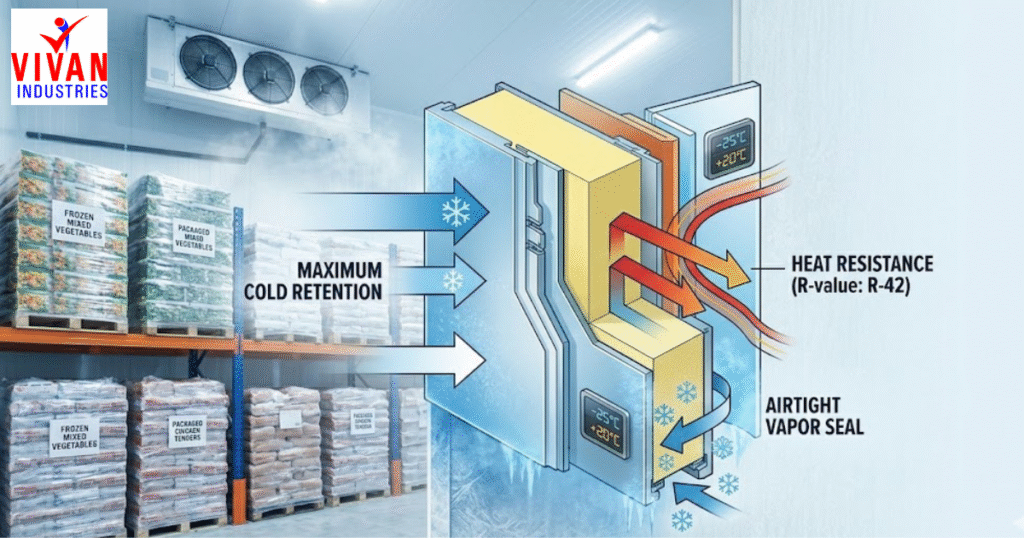
Panels now zone multi-temp: +5°C for fruits, -18°C for frozen. Cold rooms use 80mm walls/ceiling; walkables handle 5kN/m² forklifts.
Case Study: Vadodara 2025 Vivan Industries project—10,000 sqm PIR facility cut energy 25% vs 2018 PUF rebuild. Hygiene? Seamless floors prevent Listeria harbors.
Warehouses integrate solar-reflective roofs (LRV 70%), dropping roof loads 15%. Pharma demands PIR+ (Euroclass B-s1,d0).
Manufacturing & Installation Advances
CPL tech rules 2026 India: Steel coils auto-fed, PU/PIR foamed continuously, cut to length. Tolerance: ±0.5mm vs old 2mm.
Installation: Cam-locks + PIR gaskets seal 0.1 W/m² leaks. Drones scan joints pre-startup.
Table 4: Installation Best Practices (2026)
| Step | Key Check | Tool/Tech | Defect Rate Reduction |
| Surface Prep | Level ±2mm/10m | Laser levels | 40% |
| Joint Sealing | Gasket compression 20% | PIR mastic | 60% air leaks |
| Load Testing | 2kN/m² static | Hydraulic jacks | Ensures no sag |
| Commissioning | Thermal imaging | FLIR cameras | Spots 90% bridges |
Challenges & Future Outlook
Pain Points: High upfront costs (PIR 20% more), skilled labor shortages. 2026 solution? Prefab modular pods assemble onsite in days.
2027-2030 Horizon: VIP ubiquity (R-60/inch), AI-optimized cores (self-healing foams), full recyclability. India’s PLI scheme boosts local VIP at ₹1500/sqm.
Market: Cold panels hit $2Bn by 2030, CAGR 12%. Vivan Industries PUF/PIR slabs exemplify: scalable, robust for Agra’s logistics hub.
Conclusion
Insulated Sandwich Panels for Cold Storage have come a long way — from basic EPS sheets in the 1950s to today’s smart PIR and aerogel-hybrid systems that deliver unmatched thermal performance, fire safety, and sustainability. In 2026, with India’s cold chain industry targeting 100MT capacity and energy costs rising every year, choosing the right sandwich panel is no longer just a construction decision — it is a long-term business investment.
Whether you are building a new cold storage facility in Agra, retrofitting an existing pharma warehouse, or scaling up a multi-temperature logistics hub, PIR sandwich panels offer the best balance of thermal efficiency, fire safety, and ROI. With a payback period of just 2–3 years and a lifespan of 25+ years, the numbers speak for themselves.
Vivan Industries, with its proven PUF and PIR panel solutions, stands ready to support your next cold storage project — delivering quality, customization, and energy savings built for India’s climate and industry demands.
Frequently Asked Questions (FAQ)
Q1. What are sandwich panels for cold storage made of?
Sandwich panels consist of three layers — two metal face sheets (usually pre-painted galvanized iron or PPGI) bonded to a rigid insulation core such as PUF, PIR, or EPS. The core provides thermal insulation while the metal skins offer structural strength and durability.
Q2. Which is better for cold storage — PUF or PIR panels?
Both are widely used, but PIR panels are generally superior for cold storage in 2026. PIR offers slightly better thermal conductivity (0.022 vs 0.024 W/mK), higher fire resistance (Class 0 vs Class 1), greater compressive strength, and a longer lifespan of 25+ years. PUF remains a cost-effective choice for budget-sensitive projects.
Q3. What thickness of sandwich panel is recommended for cold storage?
For standard cold rooms operating at 0°C to +5°C, 80–100mm panels are typically sufficient. For deep freeze applications at -18°C to -25°C, 120–150mm thickness is recommended to minimize heat ingress and reduce compressor load.
Q4. How long do sandwich panels last in Indian climate conditions?
High-quality PIR sandwich panels with UV-stabilized PPGI skins can last 25+ years with minimal maintenance, even in India’s harsh conditions — including extreme heat, monsoon humidity, and thermal cycling. PUF panels typically offer a 15–20 year lifespan.
Q5. What is the ROI on insulated sandwich panels for cold storage?
Based on 2026 energy tariffs and usage data, most cold storage projects using PIR panels achieve full return on investment within 2–3 years through reduced electricity bills, lower compressor load, and minimal maintenance costs
Q6. Are sandwich panels fire-safe for cold storage and pharma use?
PIR panels achieve BS 476 Class 0 fire rating, making them suitable for pharma, food processing, and high-risk cold storage environments. PUF panels carry a Class 1 rating and can be enhanced with fire-retardant additives for added safety.
Q7. Can Vivan Industries supply sandwich panels for large cold storage projects?
Yes. Vivan Industries offers PUF and PIR-based sandwich panels customized for cold storage walls, ceilings, and roofing in projects of all sizes — from small cold rooms to large-scale logistics warehouses across India.