
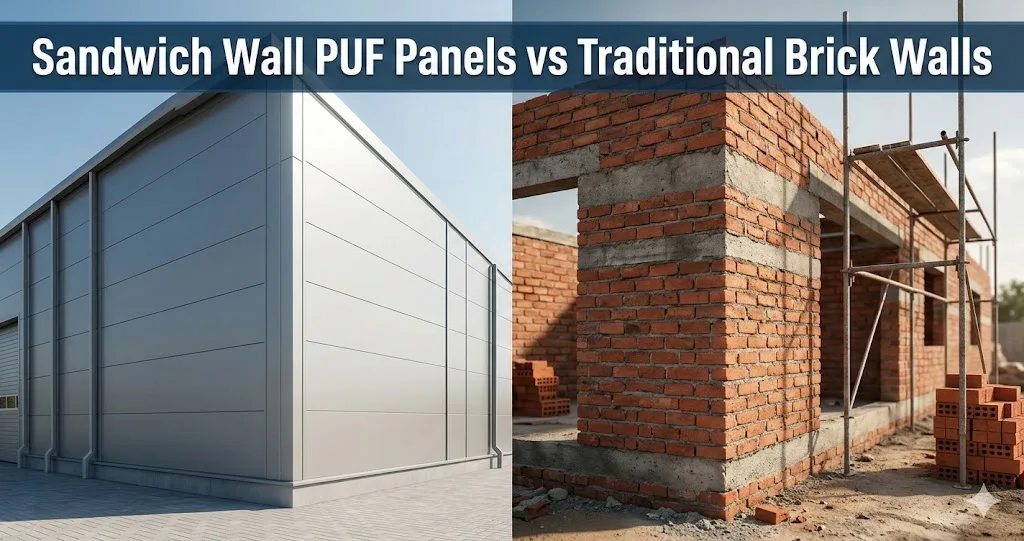
Sandwich Wall PUF Panels offer a modern prefabricated alternative to Traditional Brick Walls, revolutionizing construction with faster builds and superior insulation. This comparison explores their key differences in performance, cost, and suitability for projects like factories and warehouses in India.
What Are Sandwich Wall PUF Panels?
Sandwich Wall PUF Panels consist of two metal sheets, typically galvanized steel or aluminum, bonded to a core of rigid polyurethane foam (PUF). This design provides integrated insulation, strength, and weatherproofing in a single lightweight unit.
Manufacturers like Vivan Industries produce these panels under controlled factory conditions for consistent quality. Thicknesses range from 30mm to 100mm, with the PUF core delivering low thermal conductivity around 0.022 W/mK.
Understanding Traditional Brick Walls
Traditional Brick Walls use fired clay bricks laid with mortar, often plastered for finishing. Common in India for residential and industrial buildings, they rely on thermal mass for temperature regulation but require separate insulation.
Bricks vary from standard clay to fly ash types, with walls typically 9-inch or 4.5-inch thick. Construction involves skilled masons, curing time, and heavy materials, making it labor-intensive.
Construction Speed Comparison
Sandwich Wall PUF Panels install rapidly, with teams covering 800-1000 sq ft per day by simply bolting or clipping panels to frames. No curing or drying waits, enabling projects to finish in days rather than weeks.
Traditional Brick Walls demand sequential laying, mortar setting (24-48 hours per layer), and 28-day full curing, often delaying timelines by months. For a 10,000 sq ft factory, PUF panels cut construction time by 70-80%.
Thermal Insulation Performance
PUF Sandwich Wall Panels excel with R-values of 30-50, reducing heat transfer and cutting HVAC costs by 30-40%. The closed-cell foam core prevents air leakage, ideal for India’s hot climate.
Brick Walls have higher thermal conductivity (0.6-1.0 W/mK), needing extra insulation like foam or plaster, which adds cost and thermal bridges. They provide mass for cooling but struggle in extreme heat without add-ons.
| Property | PUF Panels (50mm) | Brick Wall (9-inch) |
|---|---|---|
| Thermal Conductivity | 0.022 W/mK | 0.8 W/mK |
| R-Value | 40+ | 2-3 (uninsulated) |
| Energy Savings | 30-40% | Baseline |
Cost Analysis: Sandwich Wall PUF Panels vs Traditional Brick Walls Price
Sandwich Wall PUF Panels cost ₹90-₹150 per sq ft (material + installation), higher upfront but offset by savings. Long-term, lower labor, energy (₹0.5-1/sq ft/year saved), and maintenance make them economical.
Traditional Brick Walls run ₹40-₹80/sq ft for materials, but total with labor, plaster, and insulation reaches ₹100-₹150/sq ft. Hidden costs like delays and repairs add 20-30% over lifecycle.
In India 2026, for a 10,000 sq ft factory, PUF totals ₹12-15 lakhs vs brick’s ₹14-18 lakhs including extras.
Sandwich Wall PUF Panels vs Traditional Brick Walls Price favors PUF for projects over 5000 sq ft due to time and energy savings.
Structural Strength and Weight
PUF Panels are lightweight (10-15 kg/sq m) yet strong, spanning 6-8m without supports via composite action. Reduced foundation loads cut steel costs by 15-20%.
Brick Walls weigh 200-300 kg/sq m, demanding robust frames and deeper foundations. They offer compressive strength but crack under seismic stress without reinforcement.
Fire Resistance and Safety
PUF Panels achieve B2/B3 fire ratings; premium versions with PIR cores reach B1. Foam can burn but metal faces contain spread; intumescent coatings enhance safety. Brick Walls are non-combustible (A1 rating), providing superior fire resistance up to 4 hours. However, mortar joints weaken over time.
Sound Insulation Qualities
PUF Panels offer STC ratings of 25-30, sufficient for factories but needing mass loading for acoustics. The foam absorbs vibrations well. Brick Walls achieve STC 45-50 via mass, better for noise-sensitive areas. Plaster adds to performance.
| Insulation Type | PUF Panels STC | Brick Walls STC |
|---|---|---|
| Sound (Airborne) | 25-30 | 45-50 |
| Thermal | Excellent | Poor without add-ons |
Durability and Maintenance
PUF Panels last 20-30 years with minimal upkeep; corrosion-resistant coatings handle humidity. Joint seals prevent leaks if maintained. Brick Walls endure 50+ years but suffer efflorescence, cracks, and repointing every 5-10 years. Painting/plastering adds ongoing costs.
Environmental Impact
PUF Panels use less material, generate minimal site waste, and save energy (reducing CO2 by 25-30%). Recyclable facings, though foam recycling lags. Brick production is energy-intensive (firing kilns emit CO2); fly ash bricks are greener. Site waste and water use are high.
Aesthetic and Customization Options
PUF Panels come in colors/textures mimicking brick or metal, with clean lines for modern looks. Limited for curves. Brick Walls offer rustic appeal, customizable patterns, but uneven finishes need plaster.
Installation Processes
PUF Panels: Measure site, erect frame, align/clip panels, seal joints—1-2 days per 1000 sq ft.
Brick Walls: Mix mortar, lay courses level, cure layers—skilled work over weeks.
Real-World Case Studies
Mount Roof equipped an electronics factory, slashing timelines from 3 months (brick) to 2 weeks (PUF), saving ₹20 lakhs. Suchi Foams reports 40% energy cuts in warehouses.
Panjetani Buildwell’s food processing plant used PUF for hygiene and speed.
Pros and Cons Overview
PUF Panels Pros: Speed, insulation, lightweight, cost savings long-term.
Cons: Higher initial cost, lower fire/mass.
Brick Pros: Durability, fire/sound resistance, aesthetics.
Cons: Slow, heavy, poor insulation.
PUF Sandwich Wall Panels vs Brick Walls: Application Suitability
PUF Ideal For: Factories, cold storage, prefabs—where speed/energy matter. Companies like Pronto Panels dominate here.
Brick For: Homes, high-rises needing mass/acoustics.
Sandwich Wall PUF Panels vs Traditional Brick Walls shifts to PUF for industrial India 2026.
Company Spotlights
Suchi Foams offers quality PUF for smart shifts from bricks. Mount Roof engineers for factories. Panjetani Buildwell emphasizes efficiency; ePack insulated options. Pronto Panels provides budget ranges ₹104/sq ft.
Maintenance and Lifecycle Costs
PUF: Clean seals yearly, ₹1-2/sq ft/decade. Brick: Repoint/paint ₹5-10/sq ft/decade.
Future Trends in India
With urbanization, PUF demand grows 15% yearly for green builds. Govt pushes prefab under PMAY.
Conclusion
In conclusion, Sandwich Wall PUF Panels outperform Traditional Brick Walls in speed, insulation, and lifecycle costs, making PUF Sandwich Wall Panels vs Brick Walls the smarter choice for modern Indian factories. Despite higher upfront Sandwich Wall PUF Panels vs Traditional Brick Walls Price, long-term savings dominate. Opt for PUF efficiency.
Summary
Sandwich Wall PUF Panels outperform Traditional Brick Walls in speed, insulation, and lifecycle costs, ideal for modern India. PUF Sandwich Wall Panels vs Brick Walls favor panels for efficiency; Sandwich Wall PUF Panels vs Traditional Brick Walls Price evens out long-term. Choose based on needs—PUF for industrial wins.
FAQs
What is the main difference between Sandwich Wall PUF Panels vs Traditional Brick Walls?
PUF offers superior insulation and speed; bricks provide mass and fire resistance.
How does Sandwich Wall PUF Panels vs Traditional Brick Walls Price compare?
PUF ₹90-150/sq ft upfront, cheaper long-term; bricks similar total with extras.
Are PUF Sandwich Wall Panels vs Brick Walls better for factories?
Yes, faster install and energy savings.
What about fire safety in PUF panels?