
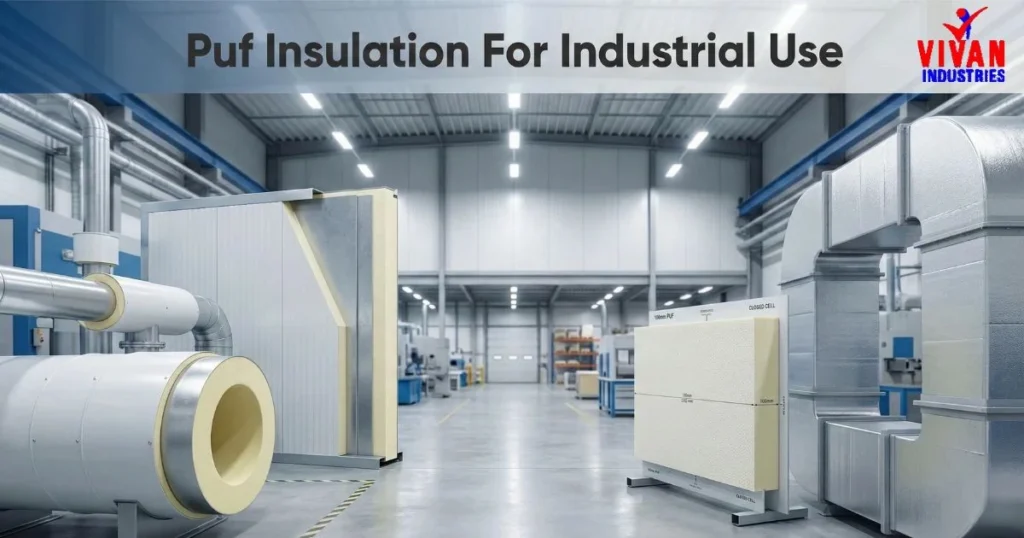
Industrial infrastructure in 2026 is no longer just about strong buildings it’s about energy efficiency, sustainability, cost control, and long-term performance. One solution that consistently delivers on all fronts is Puf Insulation For Industrial Use. From manufacturing plants to cold storage facilities, PUF insulation has become a strategic investment rather than a construction afterthought. At Vivan Industries, industrial insulation is approached as a performance system, not just a product.
Understanding Puf Insulation
PUF (Polyurethane Foam) insulation is a rigid, closed-cell insulation material created by a chemical reaction between polyol and isocyanate. Once formed, it expands and cures into a lightweight yet highly durable foam with exceptional thermal resistance.
What makes Puf Insulation For Industrial Use different from residential-grade insulation is its engineered density, load-bearing capability, and resistance to moisture, chemicals, and temperature extremes. This makes it suitable for factories that operate 24/7, warehouses storing sensitive goods, and industrial buildings exposed to harsh environments. According to global construction energy reports (2024–2025), industrial facilities with advanced insulation systems experience up to 38% reduction in energy losses compared to poorly insulated structures.
Why Puf Insulation For Industrial Use Is Critical in 2026
Industrial energy costs have increased steadily over the past decade. In parallel, governments and regulatory bodies are enforcing stricter thermal efficiency and carbon reduction norms. This is where Puf Insulation For Industrial Use becomes essential.
Key reasons driving adoption:
- Rising electricity and fuel costs
- Demand for temperature-controlled operations
- Growth of cold chain and logistics infrastructure
- Sustainability and ESG compliance
Industries that fail to upgrade insulation often face higher operational expenses and regulatory risks. Vivan Industries addresses these challenges by delivering insulation solutions aligned with future-ready industrial standards.
How Puf Insulation Works
PUF insulation works by trapping gas inside millions of microscopic closed cells. These cells dramatically slow down heat transfer through conduction, convection, and radiation.
Functional benefits include:
- Reduced heat gain during summer
- Retention of warmth in cold environments
- Elimination of thermal bridges
- Strong resistance to condensation
Once installed, Puf Insulation For Industrial Use creates a continuous thermal barrier that stabilizes indoor conditions regardless of external climate fluctuations.
Core Advantages of Puf Insulation For Industrial Use
PUF insulation offers a combination of technical and economic benefits unmatched by traditional materials.
Operational Benefits
- Stable internal temperatures
- Improved productivity in controlled environments
- Reduced HVAC load and breakdowns
Financial Benefits
- Significant energy savings year after year
- Lower maintenance and repair costs
- Faster payback period (typically 2–3 years)
Structural Benefits
- Adds rigidity to roofs and wall systems
- Resistant to moisture, corrosion, and pests
These advantages make Puf Insulation For Industrial Use a long-term performance solution rather than a short-term expense.
Industrial Applications of PUF Insulation
PUF insulation is widely used across multiple industrial sectors:
- Manufacturing plants
- Cold storage and refrigerated warehouses
- Pharmaceutical and clean-room facilities
- Food processing units
- Logistics and distribution centers
In cold storage alone, proper insulation can reduce energy consumption by 30–45%, making PUF a preferred choice.
Roofing and Wall Insulation Systems
Industrial roofs and walls are the primary sources of heat loss and heat gain. This is why roofing puf insulation panels are extensively used in large-span industrial buildings.
PUF-insulated roofs:
- Reflect external heat
- Prevent water seepage
- Minimize condensation
For walls, insulated systems improve both thermal and acoustic comfort, especially in high-noise production areas.
Panel Types and Structural Configurations
One of the most popular industrial solutions is the sandwich puf panel, which consists of a PUF core bonded between two metal sheets. This configuration provides strength, insulation, and fast installation in one system.
| Panel Type | Application | Key Benefit |
| PUF Wall Panels | Factories & warehouses | Thermal + acoustic control |
| PUF Roof Panels | Industrial sheds | Heat resistance |
| Insulated Doors | Cold rooms | Airtight sealing |
Vivan Industries customizes panel configurations based on load requirements and environmental exposure.
Thickness, Density, and Thermal Performance
Choosing the right thickness and density is critical for insulation efficiency.
| Thickness | Suitable Use | Performance Level |
| 30–40 mm | Light industrial | Moderate insulation |
| 50 mm thick puf panel | Standard industrial use | High efficiency |
| 80–100 mm | Cold storage | Maximum thermal resistance |
Density selection is often guided by performance benchmarks referenced from the High Density Insulation Foam, ensuring optimal results without over-engineering.
Comparison With Conventional Insulation Materials
| Parameter | PUF Insulation | Mineral Wool |
| Thermal Conductivity | Very low | Moderate |
| Moisture Resistance | Excellent | Poor |
| Lifespan | 20–30 years | 8–12 years |
| Installation Speed | Fast | Slow |
This comparison clearly explains why Puf Insulation For Industrial Use outperforms conventional insulation in demanding environments.
Energy Efficiency, Sustainability, and Compliance
Modern PUF systems use low-GWP blowing agents, supporting global sustainability goals. Facilities insulated with PUF show measurable improvements in:
- Carbon emission reduction
- Indoor environmental quality
- Compliance with ISO and green building standards
Vivan Industries designs insulation solutions that align with both economic and environmental priorities.
Installation Process and Best Practices
Proper installation determines long-term performance. Best practices include:
- Surface leveling and sealing
- Precision panel alignment
- Joint treatment to avoid air leakage
- Final thermal inspection
Working with experienced teams ensures Puf Insulation For Industrial Use delivers its full potential.
Cost, ROI, and Lifecycle Value
Although PUF insulation may have a higher upfront cost, the long-term savings are substantial.
| Cost Aspect | Short Term | Long Term |
| Energy Bills | Reduced | Significantly reduced |
| Maintenance | Minimal | Very low |
| Replacement | Not required | 20–30 years |
Most industrial projects achieve ROI within 24–36 months.
Maintenance, Durability, and Safety
PUF insulation requires minimal maintenance. It resists:
- Mold growth
- Water absorption
- Structural degradation
Fire-retardant grades are available for industrial compliance, ensuring safety without compromising performance.
Why Choose Vivan Industries
Choosing the right supplier is as important as choosing the right insulation. Vivan Industries offers:
- Industry-specific insulation expertise
- Certified raw materials
- Customized engineering solutions
- End-to-end project support
Every Puf Insulation For Industrial Use project is designed to deliver efficiency, durability, and measurable ROI.
Conclusion
In today’s competitive industrial landscape, Puf Insulation For Industrial Use is not a luxury it is a necessity. It improves energy efficiency, reduces operating costs, and supports sustainability goals while delivering long-term durability. With proven expertise and a performance-driven approach, Vivan Industries continues to help industries build smarter, safer, and more efficient facilities. Investing in the right insulation today ensures operational stability and cost savings for decades to come.
FAQs
What makes PUF insulation ideal for industrial buildings?
Its high thermal efficiency, durability, and low maintenance.
How long does PUF insulation last?
Typically 20–30 years with proper installation.
Is PUF insulation suitable for hot climates?
Yes, it significantly reduces heat ingress.
Can PUF insulation handle heavy industrial loads?
Yes, when engineered with proper density.
Is it environmentally safe?
Modern PUF formulations are eco-compliant.